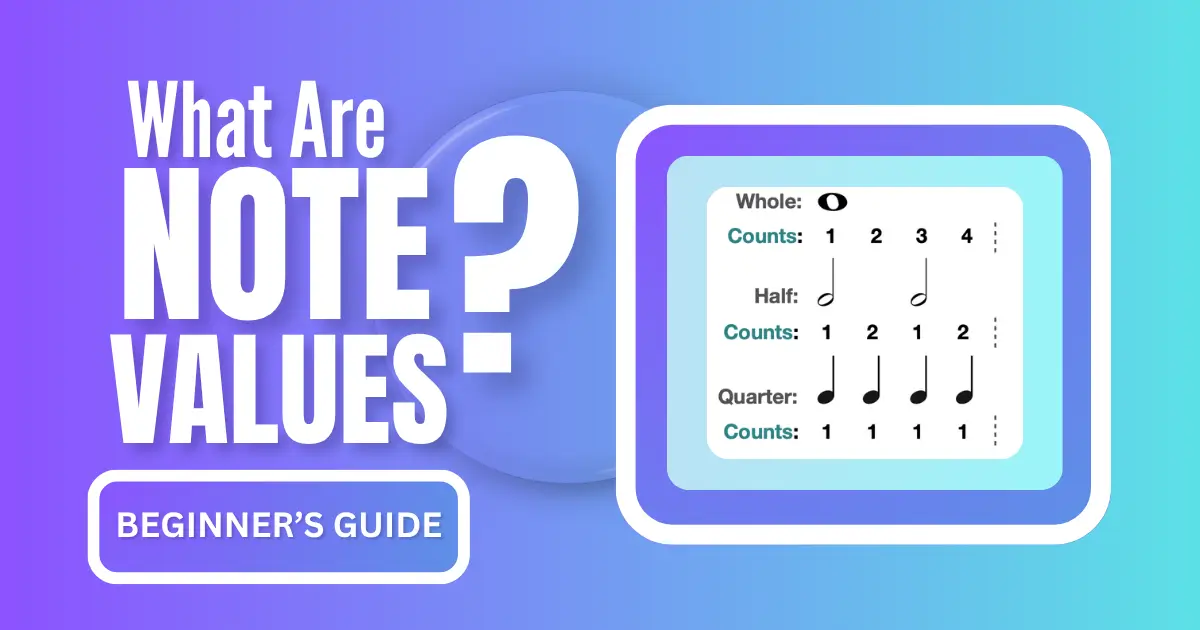
Note values are the building blocks of rhythm in music. They show us how long each sound or silence should last when we play or sing a song. Whether it’s a long, held note or a short, quick beat, knowing your note values helps you read music better and stay in time.
In this guide, you’ll learn the most common types of notes and rests, how to count them, and what dotted notes and ties mean—all in a way that’s simple and fun. Let’s dive in and make rhythm easy to understand!
What Are Note Values?
Note values (also called note durations) tell you how long a note lasts in music. Some notes are short (quick sounds), while others are long (slow sounds).
When you read music, these values help you keep time, stay in rhythm, and play or sing the right way.
🎧 Think of note values like building blocks of rhythm. Without them, music would just be noise!
Types of Note Values (with Symbols and Beat Counts)
In music, note values show how long to hold or play a note. Each type of note has a different duration. Here are the main types of note values every music student should know:
Whole Note or Semibreve (𝅝)
- Beats: 4 beats
- Looks like: A hollow oval with no stem
- Fun fact: It fills an entire 4/4 measure!
Count it as: “1 – 2 – 3 – 4”
Half Note or Minim (𝅗𝅥)
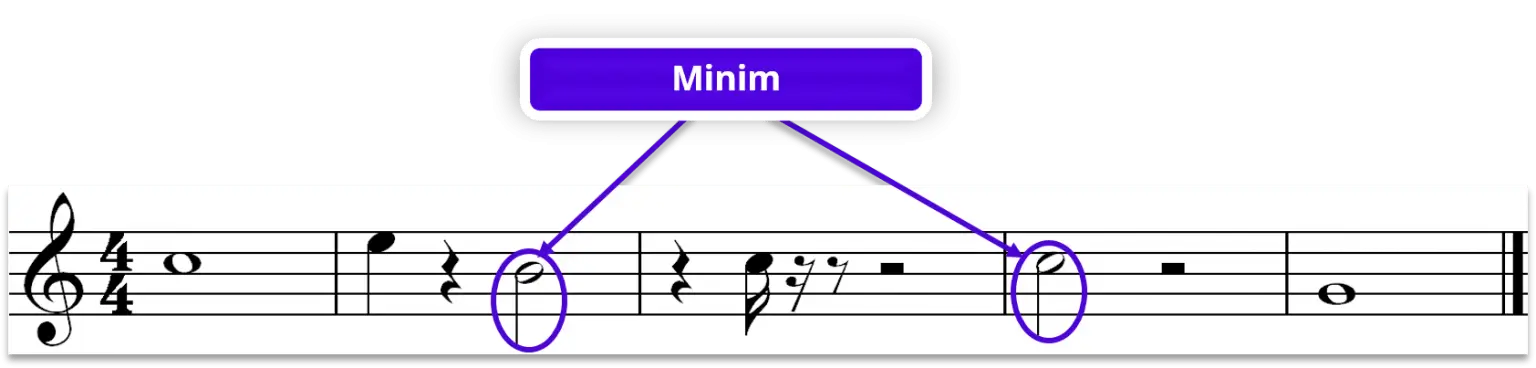
- Beats: 2 beats
- Looks like: A hollow note with a stem
- Tip: Two half notes equal one whole note.
Count it as: “1 – 2”
Quarter Note or Crotchet (𝅘𝅥)
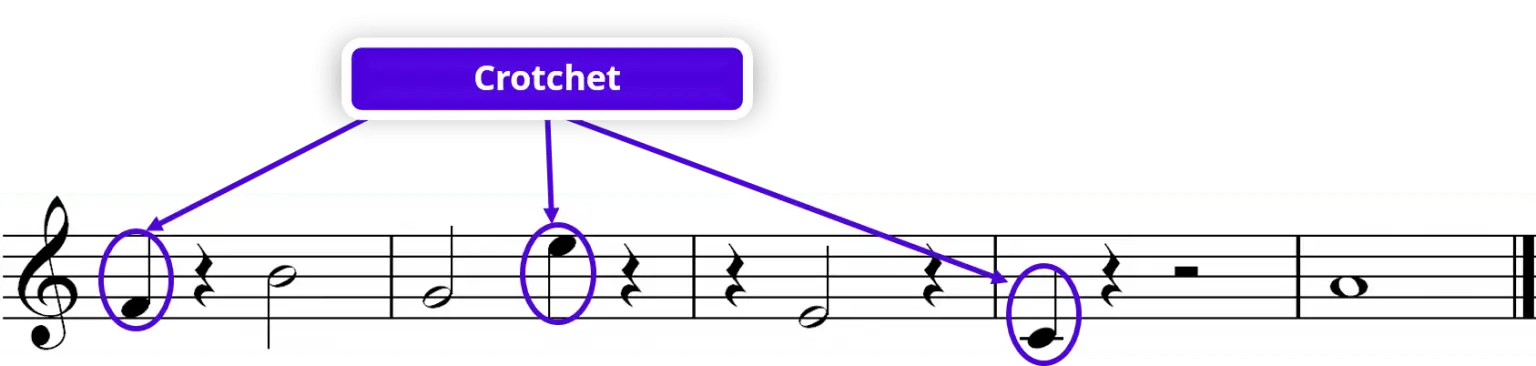
- Beats: 1 beat
- Looks like: A filled-in note with a stem
- Most common note in beginner music.
Count it as: “1”
Eighth Note or Quaver (𝅘𝅥𝅮)
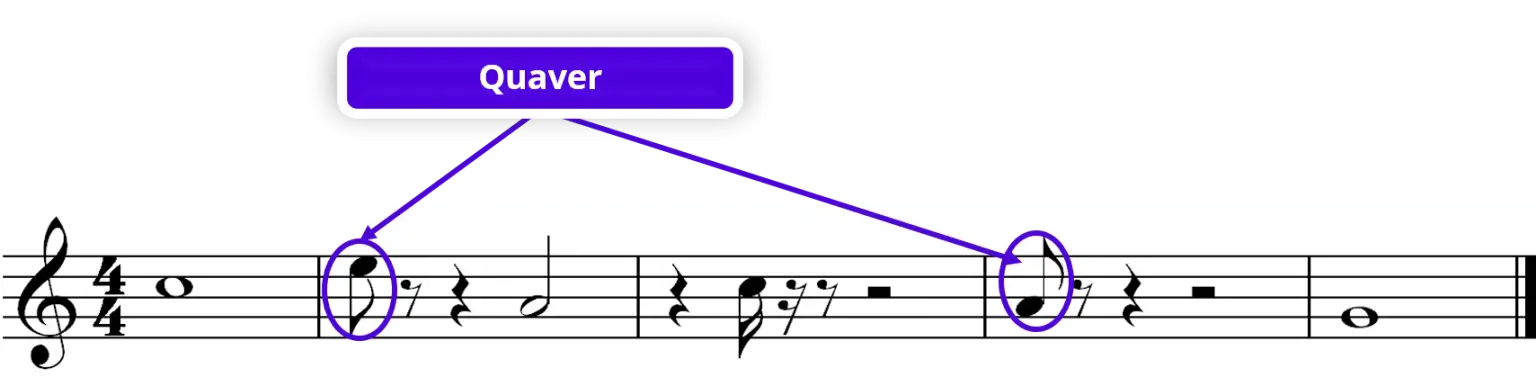
- Beats: ½ beat
- Looks like: A filled-in note with a stem and one flag
- Tip: Two eighth notes = one quarter note
Count as pairs: “1 &” or “1-and”
Check this lessons to for in-depth explanation on music theory.
- Music Theory for Beginners: Recipe For Every Musician
- Happy Birthday Tonic Solfa
- Piano Chord Inversions Made Easy
Sixteenth Note or Semi – quaver (𝅘𝅥𝅯)
- Beats: ¼ beat
- Looks like: Like an eighth note but with two flags
- Fastest common note used in beginner to intermediate music
Count as: “1 e & a”
Note Values Chart (with Beats)
| Note Symbol | American Name | British Name | Beats (4/4 Time) |
|---|---|---|---|
| 𝅝 | Whole Note | Semibreve | 4 beats |
| 𝅗𝅥 | Half Note | Minim | 2 beats |
| 𝅘𝅥 | Quarter Note | Crotchet | 1 beat |
| 𝅘𝅥𝅮 | Eighth Note | Quaver | ½ beat |
| 𝅘𝅥𝅯 | Sixteenth Note | Semiquaver | ¼ beat |
| 𝅘𝅥𝅰 | Thirty-second Note | Demisemiquaver | ⅛ beat |
| 𝅘𝅥𝅱 | Sixty-fourth Note | Hemidemisemiquaver | 1/16 beat |
Parts of a Musical Note
A musical note that shows duration can have up to three parts:
1. Notehead
- The main round part of the note.
- Can be filled (black) or open (white).
| Note | Notehead Type | Example |
|---|---|---|
| Whole note | Open (white), no stem | 𝅝 |
| Half note | Open (white), with stem | 𝅗𝅥 |
| Quarter note and shorter | Filled (black), with stem | 𝅘𝅥 𝅘𝅥𝅮 𝅘𝅥𝅯 |
2. Stem
- A vertical line attached to the notehead.
- Notes shorter than a whole note have a stem.
- Direction depends on the note’s position on the staff (see “Guidelines for Note Stems”).
3. Flag or Beam
- Used to shorten the note duration even more.
- Flags are curved lines for single notes.
- Beams are horizontal lines connecting multiple notes (usually eighth notes or shorter).
| Note Name | Flag/Beam | Duration |
|---|---|---|
| Eighth note | 1 flag or 1 beam | ½ beat (in 4/4 time) |
| Sixteenth note | 2 flags/beams | ¼ beat |
| Thirty-second note | 3 flags/beams | ⅛ beat |
Basic Note Stem Rules
- Stem Direction:
- If the notehead is below the middle line of the staff, the stem goes up on the right side of the notehead.
- If the notehead is on or above the middle line, the stem goes down on the left side of the notehead.
- Stem Length:
- A stem should extend an octave (about 3.5 staff spaces) from the notehead.
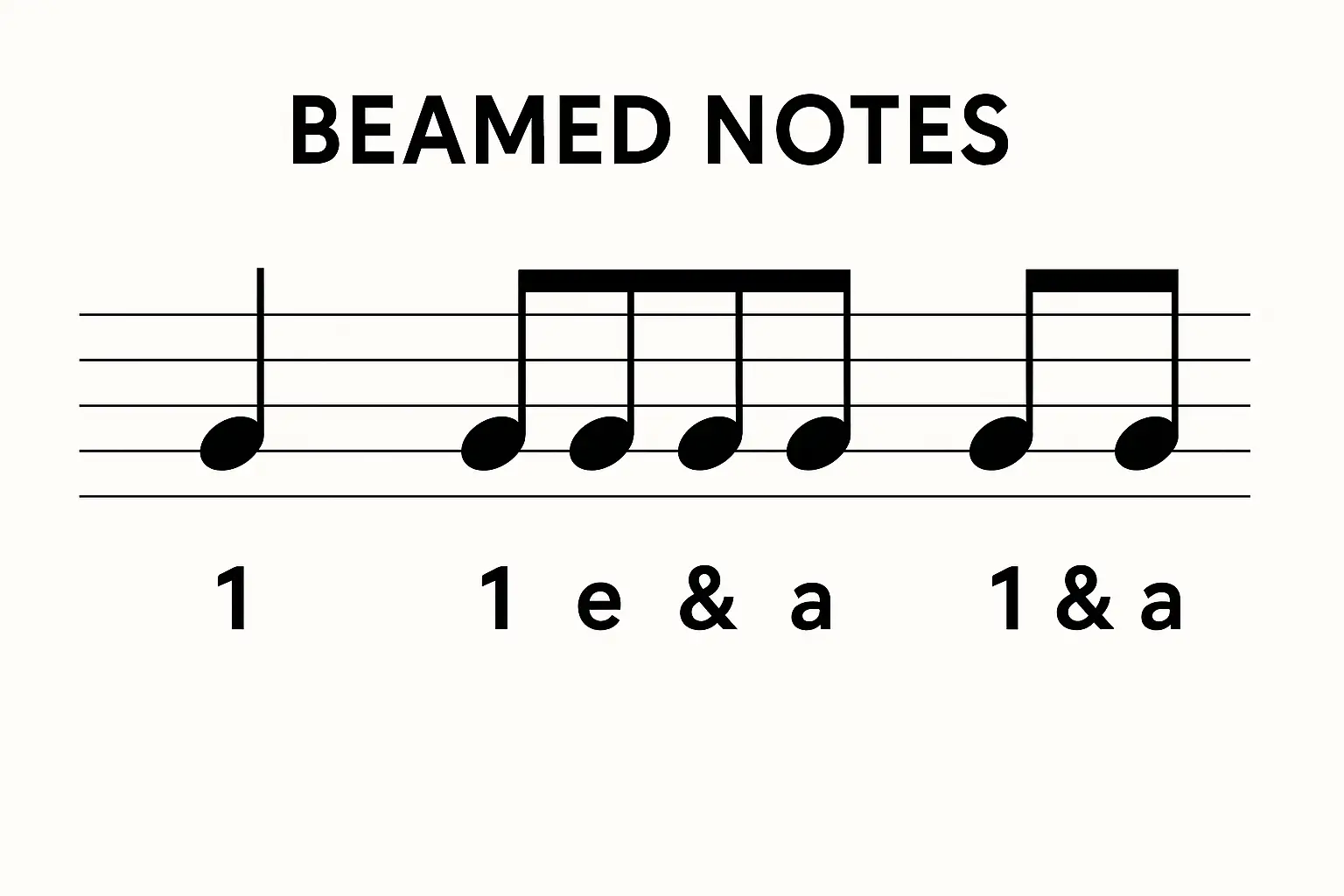
What Are Beamed Notes?
Beamed notes are groups of shorter note values—like eighth notes (𝅘𝅥𝅮) or sixteenth notes (𝅘𝅥𝅯)—that are connected by horizontal lines, called beams, instead of having individual flags.
This makes it easier to read rhythms and group notes by beat.
Beamed Notes (eighth notes and shorter):
When notes are connected with beams, stem directions are chosen based on the average position of the group:
- If most notes are above the middle line, stems go down.
- If most are below, stems go up.
- If evenly split, follow the stem direction of the note farthest from the middle line.
Examples of Beamed Notes
What Are Musical Rests in Music?
Musical rests are silent beats—you don’t play, sing, or clap during a rest, but you still count it. Here’s how to count each type of rest using 4/4 time (4 beats in each bar).
Whole Rest (𝄻)
Lasts 4 beats
- Count silently:
- 1 – 2 – 3 – 4 (no sound, just count in your head)
You can also clap the beat, but stay silent on the rest.
Half Rest (𝄼)
- Lasts 2 beats
- Count silently:
1 – 2 or 3 – 4
Quarter Rest (𝄽)
- Lasts 1 beat
- Count: say “shh” or think the number
Eighth Rest (𝄾)
- Lasts half a beat
- Count: 1 & — if the rest is on “1”, you say “shh” on 1 and clap on “&” (or vice versa)
Sixteenth Rest (𝄿)
- Lasts ¼ beat
- Count in 1 e & a rhythm
- Say “shh” where the rest is placed
Dotted Notes in Music
A dotted note means you add half of the note’s value to itself. 🎯
So the note becomes longer than usual!
What Does the Dot Mean?
A dot after a note =
Original note + half of its value
Example:
- Dotted Half Note = Half note (2 beats) + 1 beat = 3 beats
- Dotted Quarter Note = Quarter note (1 beat) + ½ beat = 1½ beats
How to Count Each One
1. Dotted Whole Note (6 beats)
- Hold it for 6 full beats
- Count: 1 – 2 – 3 – 4 – 5 – 6
- Base note: Half note = 4 beats
- Add 2 more beats
2. Dotted Half Note (3 beats)
- Hold it for 3 full beats
- Count: 1 – 2 – 3
- Base note: Half note = 2 beats
- Add 1 more beat
3. Dotted Quarter Note (1½ beats)
- Base: Quarter note = 1 beat
- Add ½ beat
- Used in compound rhythms
- Count: 1 – &
👉 You hold through beat 1 and the “and” before beat 2.
4. Dotted Eighth Note (¾ beat)
- Base: Eighth note = ½ beat
- Add ¼ beat
- Used in syncopated or fast rhythms
🗣 Count: 1 – e – &
👉 You play the next note on a
5. Dotted Sixteenth Note?
- A sixteenth note = ¼ beat
- A dot adds half of that → ¼ ÷ 2 = ⅛
- Dotted sixteenth = ¼ + ⅛ = ⅜ beat
Dotted Notes Breakdown (with Counting)
| Dotted Note | Base Note Value | Extra (½ of base) | Total Duration | How to Count It |
|---|---|---|---|---|
| Dotted Whole | 4 beats | 2 beats | 6 beats | 1 – 2 – 3 – 4 – 5 – 6 |
| Dotted Half | 2 beats | 1 beat | 3 beats | 1 – 2 – 3 |
| Dotted Quarter | 1 beat | ½ beat | 1½ beats | 1 – & |
| Dotted Eighth | ½ beat | ¼ beat | ¾ beat | 1 – e – & (then next on a) |
What is a Tie in Music?
A tie is a curved line that connects two (or more) notes of the same pitch. It tells the musician to combine the note durations and play them as one long note — no re-striking or repeating.
How to Count Tie Notes
Step-by-step:
- Add the note values together.
- Start playing the first note.
- Hold through the second note — do NOT play it again.
Example:
- Quarter Note (1 beat) + Half Note (2 beats) → 3 beats of seamless sound.
- How to Count: *“1-2-3”* (no pause between notes).
Why Do We Use Ties in Music?
Ties make it easier to write and read music that:
- Crosses bar lines
- Includes odd or uneven beats
- Needs smooth, held notes for expression
- Uses syncopation (off-beat rhythms)
Tie Note Chart (Examples with Total Beats)
| Tied Notes | Total Beats |
|---|---|
| Quarter + Quarter | 2 beats |
| Half + Quarter | 3 beats |
| Eighth + Eighth | 1 beat |
| Dotted Quarter + Eighth | 1.5 beats |
| Sixteenth + Dotted Eighth | 1 beat |
What Is a Slur in Music?
A slur is a curved line that connects two or more notes of different pitches. It tells the musician to play them smoothly and connected — this is called legato playing.
👉 Think of a slur like a musical “glue” — no space or gap between the notes.
How Does a Slur Work?
You don’t pause between the notes under the slur. You also don’t separate them with your tongue (if you’re a wind player) or fingers (if you’re on piano, violin, etc.).
On piano:
- Play the notes without lifting your fingers too high.
On violin:
- Use one bow stroke for all notes under the slur.
On trumpet:
- Blow once, and don’t tongue each note — let them flow!
Why Use a Slur in Music?
Slurs help make music sound beautiful and expressive. They:
- Add flow and emotion
- Help shape musical phrases
- Show when to play legato
- Make melodies sound connected, not choppy
Real Example of a Slur
Let’s say you see these notes:
🎵 C – D – E – F
With a slur line over them → You play them smoothly, with no gaps.
Tie vs Slur (Don’t Confuse Them!)
| Feature | Tie | Slur |
|---|---|---|
| Notes | Same pitch | Different pitches |
| Purpose | Extend duration | Play smoothly/legato |
| Counted As | One longer note | Each note played, but connected |
Pro Tip: If the notes are different pitches, it’s a slur. If they’re the same, it’s a tie.
Common Mistakes & Fixes
- Rushing Dotted Rhythms:
- Fix: Subdivide beats with a metronome app’s triplet mode.
- Ignoring Ties:
- Fix: Circle ties in your sheet music and count their total beats aloud.
- Mixing Up Dots and Staccato:
- Dot: Adds length.
- Staccato: Shortens the note (tiny dot under the note).
Real-World Examples
- “Für Elise” (Beethoven): The iconic opening uses dotted eighth notes for its haunting groove.
- “Star-Spangled Banner”: The line “O say can you see” ties notes across measures for dramatic sustain.
Tools For Practicing Note Values
- Rhythm Randomizer Apps: Generate endless counting drills.
- AI Vocal Coaches: Apps like Vocalive listen and correct your counting in real-time.
- AR Sheet Music: Point your phone at sheet music → app overlays counting syllables.
Final Thought on Note Values
Note values are the building blocks of rhythm in music. They tell us how long to hold a sound — just like how syllables create timing in spoken words.
By understanding note values like whole notes, half notes, quarter notes, eighth notes, and rests, you’re learning how music moves in time.
Here’s what to remember:
- Longer notes = slower rhythm
- Shorter notes = quicker rhythm
- Rests = silence that counts just as much as sound
- All note values are related like a family — they divide into each other to create rhythm patterns.
So next time you read music, don’t just look at the pitch — feel the rhythm too!
FAQs About Note Values
What are note values in music?
Note values tell us how long a note should be held when playing or singing. They are measured in beats and include notes like whole notes, half notes, quarter notes, and more.
What is the longest note value?
The whole note is usually the longest note value in common time. It lasts 4 beats.
What note is worth 1 beat?
In most songs written in 4/4 time, the quarter note is worth 1 beat.
What is a rest in music?
A rest is a symbol that shows a period of silence in music. Just like notes, each rest has a value (e.g., quarter rest = 1 beat of silence).
How do you count note values?
You count note values based on their beats:
What are dotted notes?
A dotted note adds half of its original value. For example, a dotted half note (2 beats) gets 1 extra beat, making it 3 beats total.
What is the difference between a tie and a slur?
A tie connects two notes of the same pitch to combine their duration.
A slur connects different notes and tells the player to play them smoothly (legato).
What are beamed notes?
Beamed notes are multiple eighth or sixteenth notes grouped together with a beam instead of individual flags. This makes rhythms easier to read.
What note is faster than a sixteenth note?
A thirty-second note is faster than a sixteenth note. It lasts ¼ of a beat in 4/4 time.