Have you ever listened to a song and wondered how musicians easily write it in tonic solfa (Do, Re, Mi)? Knowing how to find the tonic solfa of any song is a powerful skill that helps you sing better, play instruments by ear, and understand music faster.
Many learners think tonic solfa is difficult, but it is actually easy when you follow the right method. In this step-by-step guide, you will learn how to find tonic solfa of any song using simple techniques that work for both slow and fast songs.
By the end of this lesson, you will be able to listen to any song and confidently write out its tonic solfa on your own. Let’s get started!
Tonic Solfa Explained
Tonic solfa is a system of naming musical notes using simple syllables instead of letter names. The syllables are:
d – r – m – f – s – l – t – d’
Meaning of Each Syllable
| d-r-m | Full Name | Meaning |
|---|---|---|
| d | Doh | Key note (home note) |
| r | Ray | Second note |
| m | Me | Third note |
| f | Fah | Fourth note |
| s | Soh | Fifth note |
| l | Lah | Sixth note |
| t | Te | Seventh note |
| d’ | Doh | Octave (higher d) |
Unlike the letter system (C, D, E, F, G, A, B), tonic solfa is based on the key of the song. This means that d (doh) is always the first note (the “home note”) of the key. For example:
- In the key of C, d = C
- In the key of D, d = D
- In the key of F, d = F
This makes solfa flexible and easy to use across all keys.
Why Tonic Solfa is Important
Tonic solfa helps you to:
- Sing in tune
- Identify the key of a song
- Write melodies by ear
- Learn music faster
- Understand note relationships
- Transcribe songs without an instrument
How to Find Tonic Solfa of Any Song
Finding tonic solfa of a song may seem tricky at first, but it becomes easy when you follow a clear method. There are 4 simple steps on how to find tonic solfa of any song. By following these steps, you’ll be able to figure out the d–r–m solfa of any melody, whether it’s a fast song, a slow hymn, or a pop tune.
Step 1: Start Listening to Songs in Tonic Solfa
Before you try to write tonic solfa for any song, it’s important to train your ears. One of the easiest ways to do this is by listening to songs that already use tonic solfa. This first approach will guide you on how to get tonic solfa from any song.
You can find these types of songs in:
- YouTube videos (search for “tonic solfa songs” or “solfa choir training”). Check out
When you listen:
- Sing along with the solfa: do, re, mi, fa, so…
- Repeat short lines until you can sing them without help
- Try to guess what the solfa syllables are before they’re revealed
Start with songs you already know, like:
- Twinkle Twinkle Little Star Tonic Solfa
- Happy Birthday Tonic Solfa
- Nigeria National Anthem Tonic Solfa
How This Helps Students
Many students have found that listening to tonic solfa regularly improves their ear. It helps them:
- Recognize which note is “do” in a song
- Hear patterns like do–re–mi or so–so–fa–mi
- Sing more confidently in school or choir
With practice, your ear starts to remember what “do” sounds like, and how other notes relate to it. This makes it much easier to write solfa for songs by ear later on.
Step 2: Use a Keyboard or Piano App (Start in the Key of C)
Once your ears are getting used to solfa, the next step is to use a keyboard or piano app to play and sing each note. This helps you hear exactly what “do, re, mi” sound like and how they feel in your voice.
If you don’t have a real keyboard, try these free tools:
- Perfect Piano (Android)
- Walk Band
- Virtual Piano (on your computer)
Start in the Key of C
The Key of C major is perfect for beginners. It only uses the white keys—no sharps or flats.
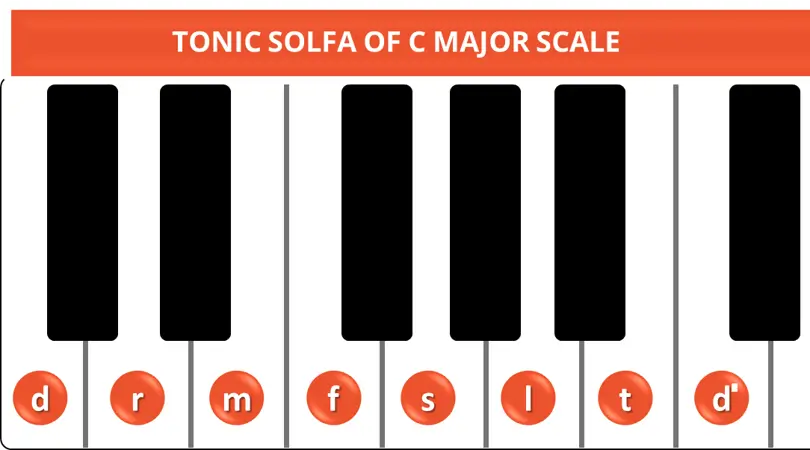
Here’s how the notes match the solfa:
- C = d
- D = r
- E = m
- F = f
- G = s
- A = l
- B = t
- C (next one) = d’
Match Your Voice with the Root Note
Before you start, press the C note (Root note) and hum it. This is your “d”.
Your voice must be in tune with the root note to get the rest of the notes correctly.
Repeat the “do” note until your voice matches it perfectly. This helps your ear stay on track.
Tips: A root note is the starting note of a key. e.g. If a singer is singing on the key of C, note C will be the root note. This means that note C will be “d”.
Don’t Sing with a Different Voice
If you sing a different pitch than the piano is playing, your tonic solfa will be wrong.
Even if you say “do,” it won’t sound correct unless your voice is matching the piano sound.
Tips: Your voice and the piano must be in sync (same pitch).
Touch Each Note One After the Other and Sing Along
Now start playing the scale slowly.
Touch each white key from C to C, and sing the solfa syllable as you go:
- Press C → sing “d”
- Press D → sing “r”
- Press E → sing “m”
- Press F → sing “f”
- Press G → sing “s”
- Press A → sing “l”
- Press B → sing “t”
- Press C (higher) → sing “d’”
Do this slowly and clearly. Don’t rush.
As you play each note, sing it out loud. This helps train your voice and ear together. The more you do it, the easier it becomes to hear solfa in any song!
Step 3: Learn Solfa Patterns Using Intervals
Now that you can sing your scale correctly using a keyboard (d–r–m–f–s–l–t–d’), the next step is to understand how solfa notes move—we call these movements intervals.
This is important because songs don’t just go straight like d–r–m–f–s… They jump around! Learning how those jumps sound and feel will help you find solfa for any melody.
What’s an Interval?
An interval is how far one note is from another. For example:
- From d to r is a small step (called a 2nd)
- From d to m is a bigger step (a 3rd)
- From d to s is a long jump (a 5th)
When you understand these jumps (intervals), it becomes easier to:
- Sing in tune with confidence
- Hear melodies by ear
- Write the tonic solfa of songs
How to Play and Sing a Tonic Solfa Interval
Intervals are the distance between two notes in a song. Using tonic solfa (do, re, mi, fa, so…), we can easily identify and sing these distances. In this guide, you’ll learn how to play and sing intervals like r–m, d–m, m–f, and f–s to improve your ear, voice, and musical skills.
d – r Tonic Solfa Interval (Major 2nd)
Let’s say we want to play d – r in the key of C major.
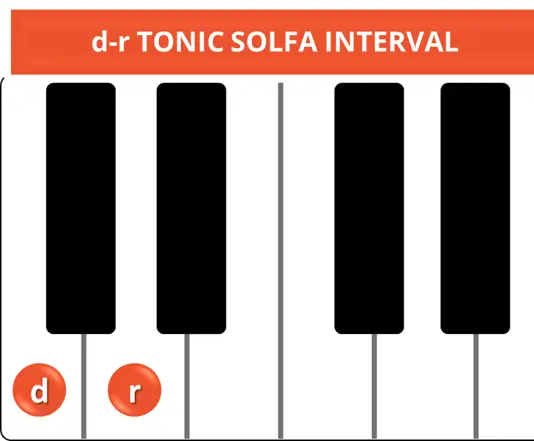
- Step 1: Start by locating note C on your keyboard.
- Step 2: Play the note C with your right thumb and sing “d” — Note C is your “d”.
- Step 3: Play the next white note D with your right index finger and sing “r” — Note D is your “r”.
- Step 4: As you press each note, sing the solfa syllable out loud.
Your voice should match the pitch of the piano. If you’re off-key, try again slowly and carefully.
RH stands for Right Hand and LH stands for Left Hand.
You’ve just played and sung a major 2nd interval!
r – m Tonic Solfa Interval (Major 2nd)
Let’s play r – m in the key of C major. This is a major 2nd interval.
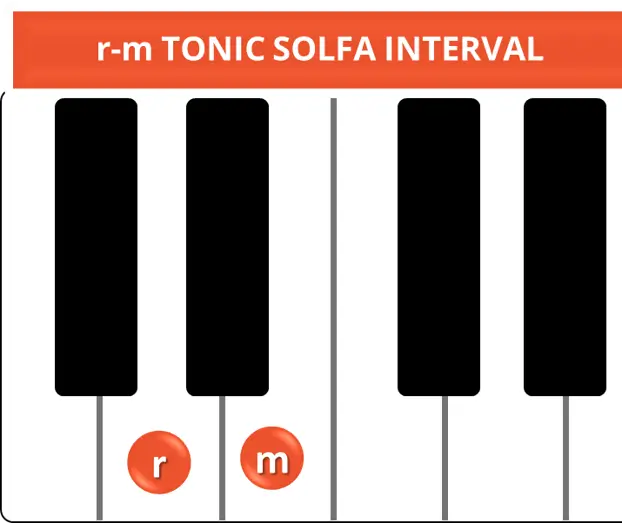
- Step 1: Play note D and sing the tonic solfa “r“.
- Step 2: Play note E and sing the tonic solfa “m“.
m – f Tonic Solfa Interval (Major 2nd)
The interval m – f is a minor 2nd (also called a half step).
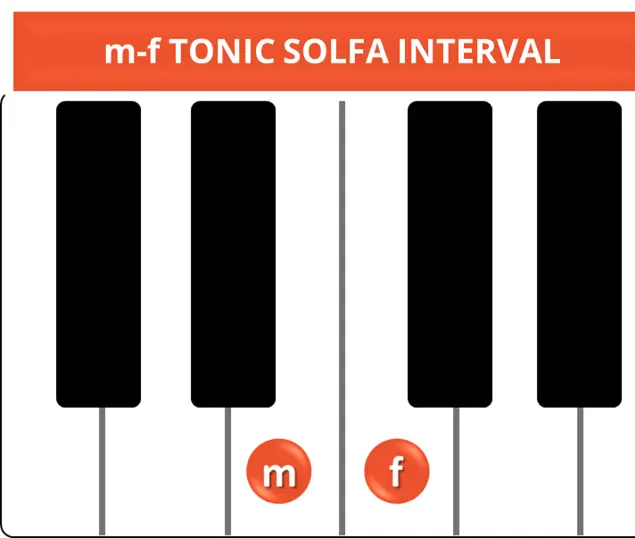
- Step 1: Play note E and sing the tonic solfa “m“.
- Step 2: Play note F and sing the tonic solfa “f“.
d – m Tonic Solfa Interval (Major 3rd)
Let’s play d – m in the key of C major. This is a major 3rd interval.
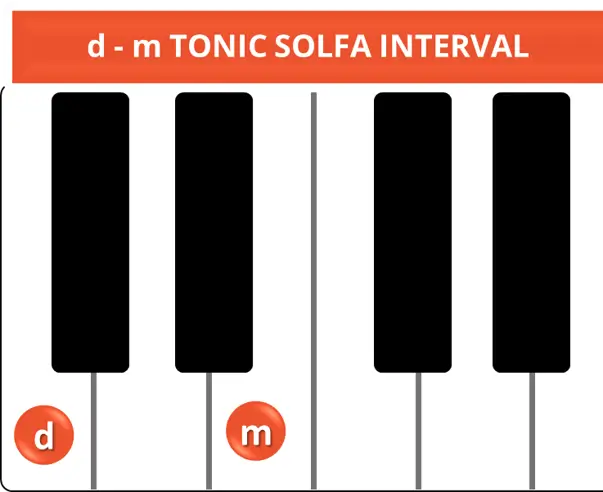
- Step 1: Play note C and sing the tonic solfa “d“.
- Step 2: Play note E and sing the tonic solfa “m“.
Congratulations. You’ve just learn how to play a major 3rd interval using tonic solfa.
d – f Tonic Solfa Interval (Perfect 4th)
Let’s have a look at how to play a Perfect 4th interval using tonic solfa.
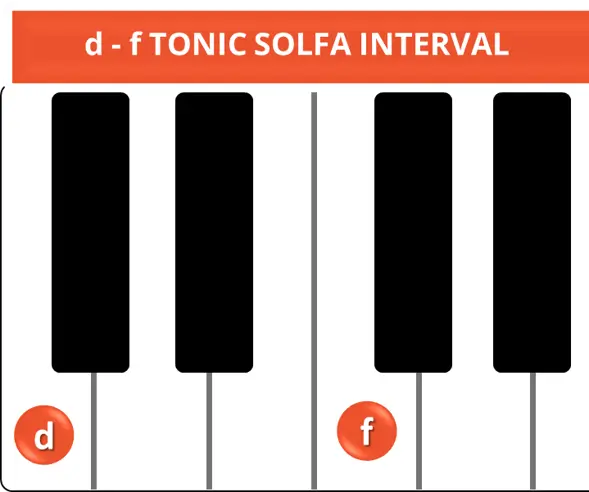
- Step 1: Play note C and sing the tonic solfa “d“.
- Step 2: Play note F and sing the tonic solfa “f“.
You are doing great. You just learn how to play and sing the Perfect 4th interval.
d – s Tonic Solfa Interval (Perfect 5th)
Next up, we will be looking at playing and singing Perfect 5th interval using tonic solfa.
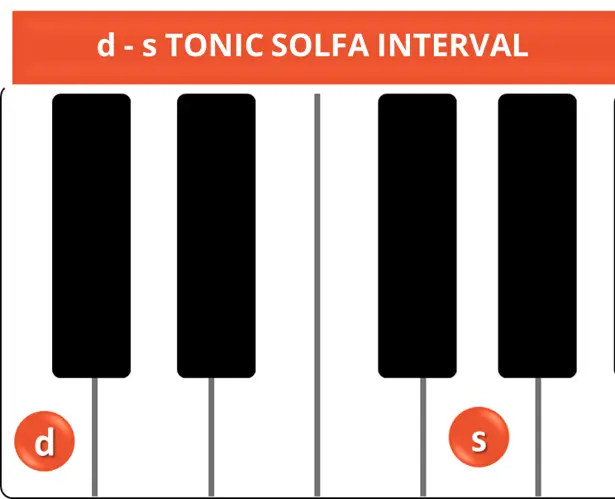
- Step 1: Play note C and sing the tonic solfa “d“.
- Step 2: Play note G and sing the tonic solfa “s“.
Now that you have build confidence in identifying the tonic solfa, use the table below to expand your ability to recognize more tonic solfa intervals.
Tonic Solfa Intervals on key C (d to s)
| Solfa Pair | Notes Played | Interval Name | Finger on 1st Note | Finger on 2nd Note |
|---|---|---|---|---|
| d – r | C – D | Major 2nd | 1 (thumb) | 2 (index) |
| d – m | C – E | Major 3rd | 1 | 3 (middle) |
| d – f | C – F | Perfect 4th | 1 | 4 (ring) |
| d – s | C – G | Perfect 5th | 1 | 5 (pinky) |
| r – m | D – E | Major 2nd | 1 | 2 |
| r – f | D – F | Minor 3rd | 1 | 3 |
| r – s | D – G | Perfect 4th | 1 | 5 |
| m – f | E – F | Minor 2nd | 1 | 2 |
| m – s | E – G | Minor 3rd | 1 | 3 |
| f – s | F – G | Major 2nd | 1 | 2 |
This table gives you:
- A practical way to play and sing solfa combinations.
- Accurate interval names to build your ear training.
- Finger guidance for right-hand piano playing in C major.
Tonic Solfa Intervals on key C (upper + lower note)
| Solfa Pair | Notes Played | Interval Name | Finger on 1st Note | Finger on 2nd Note |
|---|---|---|---|---|
| l(low) – t(low) | A – B | Major 2nd | 1 (thumb) | 2 (index) |
| l(low) – d | A – C | Minor 3rd | 1 | 3 (middle) |
| l(low) – r | A – D | Perfect 4th | 1 | 4 (ring) |
| l(low) – m | A – E | Perfect 5th | 1 | 5 (pinky) |
| t(low) – d | B – C | Minor 2nd | 1 | 2 |
| t(low) – r | B – D | Minor 3rd | 1 | 3 |
| t(low) – m | B – E | Perfect 4th | 1 | 4 |
| s (low) – d | G – C | Perfect 4th | 1 | 5 |
| s (low) – r | G – D | Perfect 5th | 1 | 5 |
| d – d (high) | C – C | Perfect Octave | 1 | 5 |
This table supports:
- Singing between lower and upper solfa tones.
- Developing octave awareness and voice placement.
- Training fingers for stretch and reach while singing correctly.
Step 4: Play Major Scales on All Keys
Now that you’ve started listening to songs in tonic solfa, used a keyboard or piano app, and practiced solfa patterns using intervals, the next step is to learn how to play major scales on all keys. This step is essential because every song belongs to a key, and being comfortable with scales allows you to figure out the tonic solfa of any song quickly.
Why This Step Matters
Playing major scales in all keys helps you:
- Identify the starting note (d) of any song
- Understand the relationship between notes in the key
- Match melody notes to the correct d–r–m solfa
- Transpose songs to different keys without losing accuracy
What is a Major Scale?
A major scale is a sequence of 8 notes that follows a specific pattern of whole steps (W) and half steps (H):
Pattern: W – W – H – W – W – W – H
- Whole step (W): Move two keys/note positions apart
- Half step (H): Move to the very next key/note
This pattern is the same for every major scale, which makes it easy to transpose scales to different keys once you know the system.
Start with the C Major Scale
C Major is the easiest scale because it has no sharps or flats:
C Major Notes: C – D – E – F – G – A – B – C
Intervals:
- C → D = W
- D → E = W
- E → F = H
- F → G = W
- G → A = W
- A → B = W
- B → C = H
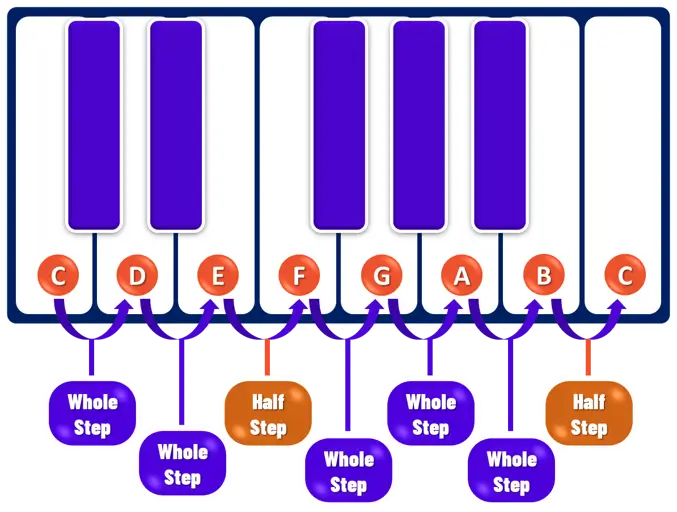
Practice this scale slowly, focusing on correct fingering and even timing.
Learn the Pattern
Remember the W – W – H – W – W – W – H pattern. Once you internalize it, you can create a major scale starting on any note.
- Example: G Major
Start on G: G → A → B → C → D → E → F# → G
Play Major Scales in All Keys
Here’s a reference for all 12 major scales:
| Key | Notes |
|---|---|
| C | C D E F G A B C |
| C# / Db | C# D# E# F# G# A# B# C# |
| D | D E F# G A B C# D |
| Eb | Eb F G Ab Bb C D Eb |
| E | E F# G# A B C# D# E |
| F | F G A Bb C D E F |
| F# / Gb | F# G# A# B C# D# E# F# |
| G | G A B C D E F# G |
| Ab | Ab Bb C Db Eb F G Ab |
| A | A B C# D E F# G# A |
| Bb | Bb C D Eb F G A Bb |
| B | B C# D# E F# G# A# B |
Start with keys with fewer sharps/flats and gradually move to more complex keys.
FAQ
Do I need to know music theory to find tonic solfa?
No advanced music theory is required. However, a basic understanding of scale degrees (d r m f s l t d), keys, and intervals will make the process significantly easier and faster.
Can tonic solfa be used for any song?
Yes. Any song—whether gospel, pop, classical, or folk—can be transcribed into tonic solfa, provided the melody is clear and you can identify the key or tonal centre.
How do I identify the key of a song correctly?
The key is usually identified by:
The starting note and ending note
The note that feels most “resolved” (the home note)
Matching the melody to a major or minor scale
With practice, key identification becomes intuitive.
What if a song changes key (modulation)?
When a song modulates, you simply reassign “Do” to the new key at the point of change. Indicate the modulation clearly in your solfa notation to avoid confusion.
Is tonic solfa suitable for piano learning?
Absolutely. Tonic solfa is especially effective for ear development, sight singing, and understanding melody structure, which directly improves piano performance.
How long does it take to master tonic solfa transcription?
With consistent practice, most learners begin to transcribe simple melodies confidently within 2–4 weeks. Mastery comes through repetition and exposure to different song styles.
Final Thought
Learning how to find the tonic solfa of any song is a transformational skill for musicians. It bridges the gap between what you hear and what you play, strengthening your musical intuition, confidence, and independence.
Rather than memorising songs mechanically, tonic solfa enables you to understand music structurally—making it easier to learn new songs, transpose effortlessly, and teach others effectively.
As with any musical skill, progress depends on consistent practice. Start with simple melodies, verify your notes using a keyboard, and gradually challenge yourself with more complex songs.
With time, you will discover that finding tonic solfa is no longer a task—it becomes second nature.