Quick Summary
- Core Concept: Tonic Solfa is a pedagogical system using syllables (Do, Re, Mi) to map pitch relationships, independent of absolute key signature.
- The Goal: To achieve “Movable Do” proficiency, allowing you to transcribe or sing any melody by ear.
- The Science: It relies on the brain’s ability to recognize frequency ratios (intervals) rather than specific Hertz frequencies.
- The Method: A 5-Phase approach moving from single-note recognition to complex harmonic audiation.
- 30-Day Plan: A structured roadmap included below to go from novice to reading SATB scores.
I. Introduction to Tonic Solfa
What is Tonic Solfa?
At its core, Tonic Solfa is a user interface for music theory. While standard staff notation maps music onto a grid of absolute frequencies (A4 = 440Hz), Tonic Solfa maps music onto a landscape of relationships.
Developed in the 19th century by Sarah Glover and refined by John Curwen, it was originally designed to democratize music education. It bypasses the complex visual decoding required for standard notation, allowing the brain to focus immediately on the sound of the interval rather than the position of a dot on a line.
Why Learn Tonic Solfa?
Most beginners struggle with music because they try to memorize absolute pitches. However, the human brain is wired for pattern recognition.
- Choral Practicality: In a choir, 90% of mistakes are interval errors. Solfa fixes this by creating a “tonal map” in your head.
- Relative Pitch vs. Perfect Pitch: You don’t need to know that a note is 440Hz (A). You only need to know it is a “Perfect Fifth” away from the home note. Solfa encodes this relationship into the syllable “So.”
Here are the top benefits of learning tonic solfa:
1. Play Melodies by Ear
With solfa, you learn to recognize pitch relationships instantly. This makes it easier to pick up tunes without needing sheet music.
2. Understand Chords and Harmony
From basic triads to complex progressions, solfa sharpens your ability to hear and play chords naturally—an essential skill for pianists, guitarists, and singers.
3. Transcribe Music Accurately
Ever wanted to write down a song just by listening? Solfa trains your ear to identify notes and intervals, making transcription much easier.
4. Transpose with Ease
Changing keys can feel tricky, but solfa gives you a system to shift any song into a new key without losing the melody or harmony.
5. Sight-Sing with Confidence
Choirs, ensembles, and solo singers all benefit from solfa. It allows you to read sheet music fluently and sing in tune right from the first try.
6. Improve Vocal Control
By practicing solfa, you strengthen pitch accuracy and breath control—helping you sing more confidently.
7. Unlock Improvisation Skills
Solfa gives you a framework to explore melodies freely while staying in key, making improvisation feel natural.
8. Write and Compose Music
If you have a melody in your head, solfa helps you bring it to life on paper or instrument. It bridges the gap between imagination and creation.
9. Make Music Theory Fun
Instead of abstract rules, solfa connects theory to sound. Intervals, scales, and chords suddenly have real meaning you can hear and feel.
II. The Foundation: The Seven Basic Notes
The Major Scale (Diatonic)
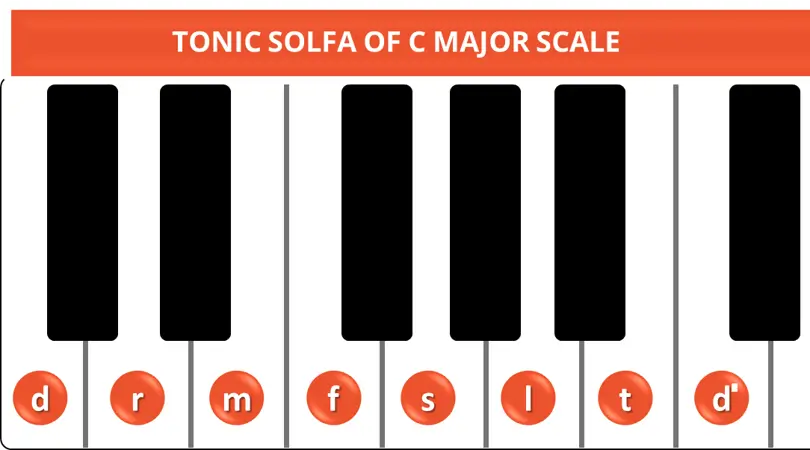
The Major Scale is built on specific frequency ratios. In Solfa, these are represented by seven syllables.
d r m f s l t dl
Which stand for:
| Solfa | Scale Degree | Corresponding Note in C Major |
|---|---|---|
| d (do) | 1st (Tonic) | C |
| r (re) | 2nd | D |
| m (mi) | 3rd | E |
| f (fa) | 4th | F |
| s (so) | 5th | G |
| l (la) | 6th | A |
| t (ti) | 7th | B |
| d′ (high do) | 8th | C (octave) |
When you sing this scale, you are navigating a mathematical ladder. For example, the relationship between Do and So is a frequency ratio of 3:2. If Do is 200Hz, So is strictly 300Hz. Solfa helps your brain internalize these math ratios as feelings.
The “Movable Do” Concept
This is the most critical concept for 2026 standards of music theory.
- Fixed Do: “Do” is always C Natural. (Common in Europe/Conservatories).
- Movable Do: “Do” is the home note of any key.
- In the Key of G Major, G = Do.
- In the Key of Eb Major, Eb = Do.
This allows you to learn one pattern and apply it to all 12 musical keys immediately.
Curwen Hand Signs: Visualizing Frequency
John Curwen introduced hand signs to engage kinesthetic memory. By associating a physical position with a pitch, you create a dual-neural pathway (auditory + motor).
- Do: A fist (Stability, the rock).
- So: Open hand, palm facing chest (Bright, bold).
- Ti: Index finger pointing up (Unstable, wants to resolve to Do).
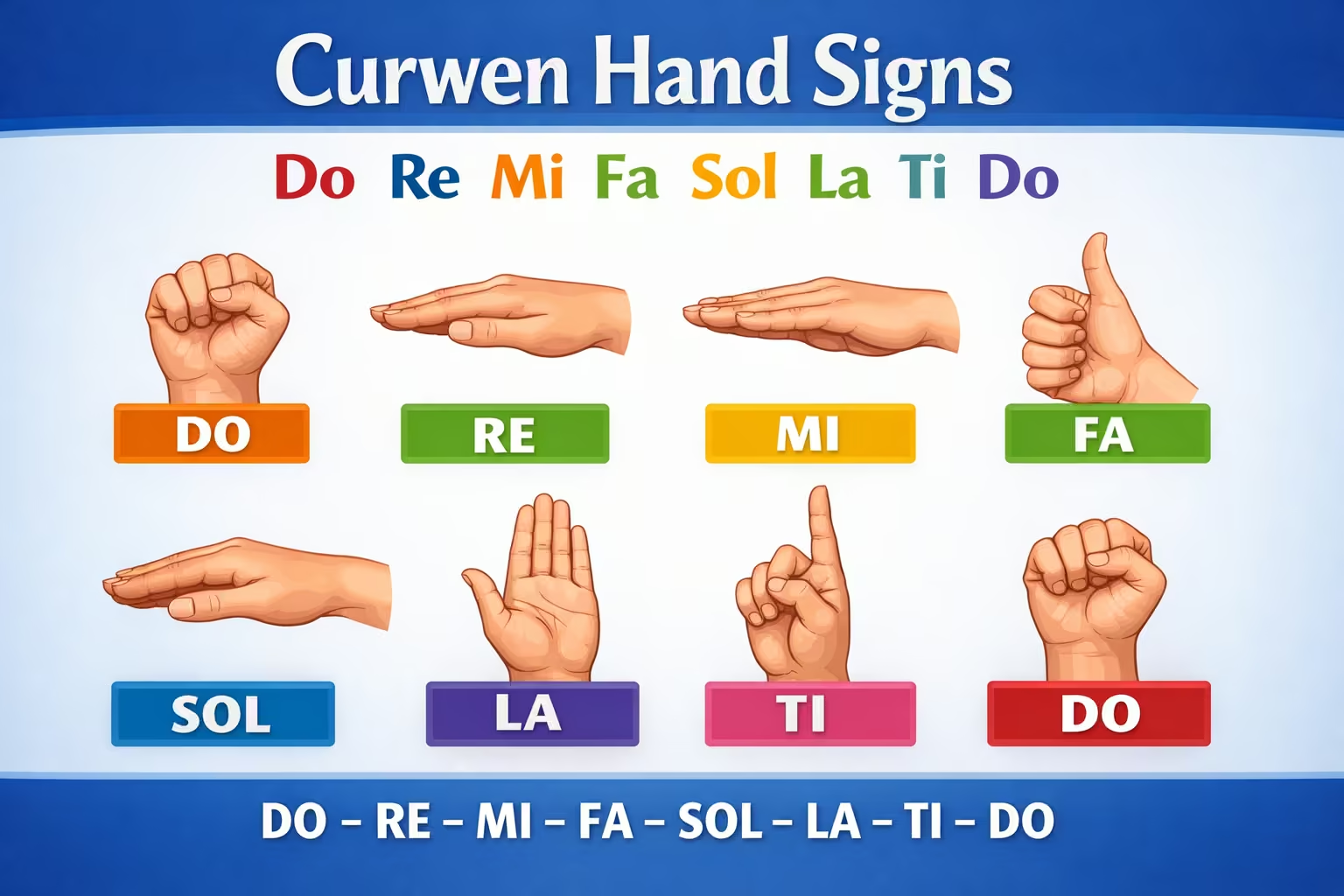
Each solfa syllable has a hand gesture that reinforces pitch movement (This is great for memory and kids):
| Syllable | Hand Sign |
|---|---|
| do (d) | Fist at waist level |
| re (r) | Palm slanted up |
| mi (m) | Flat palm |
| fa (f) | Thumb down |
| so (s) | Palm facing out |
| la (l) | Curved hand |
| ti (t) | Point upward |
| do’ (d’) | Fist higher than starting do |
III. Rhythm and Time Notation in Solfa
Standard notation uses shapes (circles, stems, flags). Tonic Solfa uses punctuation. This is often more intuitive for linguistic thinkers.
The Pulse and the Beat
1. Bar Line (|)
The music is divided into measures using bar lines (|). Within measures, beats are divided by colons (:).
- Strong Beat: The start of a bar
|. - Weak Beat: The colon
:.
Example:d r m | f s l | t d′ ‖
2. Double Bar Line (‖)
- What it means: Shows the end of a section or the music.
Example:d r m | f s l | t d′ ‖
Visualizing the Time Grid
Duple Time (2/2): ∣ Strong : Weak∣ Solfa : | d : r |
Triple Time (3/4): ∣ Strong : Weak : Weak ∣ Solfa: | d : r : m |
Quadruple Time (4/4): ∣ Strong : Weak ∣ Medium : Weak
∣ Solfa: | d : r | m : f |
Note Durations: The Code
1. The Beat: d
What it means: A single letter is one beat.
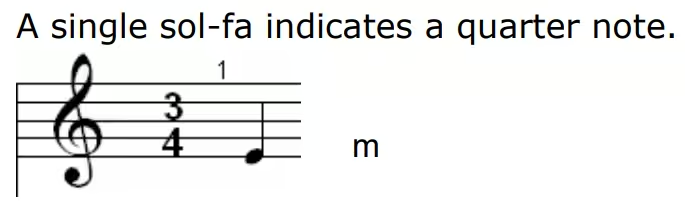
Example:
Twin-kle twin-kle Li-ttle Star
d d s s l l s :-
In the first bar which contains d d s s, the notes are each played with one beat.
2. Dash (–)
What it means: Hold the note longer (usually one more beat per dash).
Example:
d :- r :- m :- f :-
When you see a single dash line, it extends the solfa by one beat.
When you see two dash lines, it extends the solfa by two beats.
When you see three dash lines, it extends the solfa by three beats.
Dash Symbols In Table Diagram
| Notation | Beats | Explanation |
|---|---|---|
d | 1 | One beat note |
d – | 2 | Held for two beats |
d – – | 3 | Held for three beats |
d – – – | 4 | Held for four beats |
👉 Each extra dash adds one beat to the note.
5. Colon (:)
In tonic solfa notation, the colon (:) is used to show shorter or quicker notes.
Think of it like this:
| Solfa | With Colon | What it Means |
|---|---|---|
| d | d | 1 full beat (crotchet) |
| d. | d. | Half a beat (quaver) |
The Dot (.)
What it means: The Dot is used for dividing beat into half.
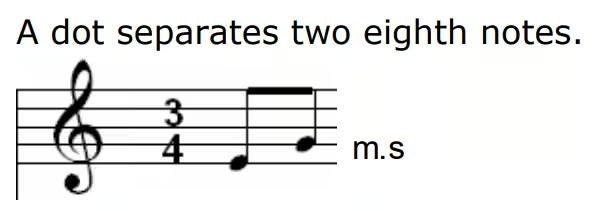
Example:
m . s = Two notes in one beat (Eighth notes/Quavers).
What it means : Used for sixteenth notes.
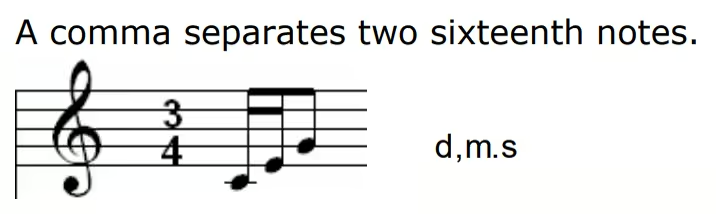
Example:
d , m = Sixteenth notes.
Rests
Silence is as important as sound. In Solfa, a rest is often merely an empty space between punctuation marks.
| d : : m |= Do (1 beat), Rest (1 beat), Mi (1 beat).
Octave Indicators in tonic solfa
In tonic solfa notation, each sol-fa symbol represents a note within one octave. When a note moves outside that octave, special markers are used to show the change:
In solfa, d (doh) is typically used as the starting point of an octave.
When tonic solfa is connected to staff notation:
- In the treble clef, plain d (without superscript or subscript) corresponds to c¹ (middle C) when the key is C.
- It extends upward to b¹ (the B above middle C) when the key is B.
This system makes it easy to understand octave placement without switching to full staff notation.
Right superscript
- Right superscript indicates a higher octave.
Example: m‘ means mi one octave above the regular mi.
Right subscript
- Right subscript indicates a lower octave.
Example: s‘ means so one octave below the regular so.
iV. Developing Your Musical Ear Intervals Training Practical Drills
To survive the era of music learning, you need actionable drills, not just theory.
The Drill: Play any pop song. Hum the note that feels like “home” or the “period at the end of the sentence.” That is Do. Once you lock onto Do, try to find So (the dominant note, usually the second most prominent).
Major Intervals Training
Before we begin ear training on major intervals using tonic solfa, Use a keyboard, piano app, or tonic solfa trainer to match pitches. Start from middle C for the C major scale and sing each solfa syllable as you play the notes.
Here are all valid major intervals from different solfa syllables in the scale: Let’s practice only the Major intervals within this full scale — from any solfa syllable:
- Major 2nd
- Major 3rd
- Major 6th
- Major 7th
Major 2nds (M2) — 1 whole step
What Is a Major 2nd in Tonic Solfa?
In tonic solfa, a Major 2nd is the distance between two consecutive syllables in the major scale. It’s the smallest melodic step between two different pitches in the scale.
How to Play a Major 2nd on Piano (with Solfa)
- Pick any key (note) as Do (
d). - Move two semitones (2 keys, including black keys) up — that gives you Re (
r). - You’ve played a Major 2nd interval.
| From → To | Solfa | C Major Example |
|---|---|---|
| d → r | d – r | C – D |
| r → m | r – m | D – E |
| f → s | f – s | F – G |
| l → t | l – t | A – B |
How to Sing a Major 2nd (Solfa Practice)
Try singing these pairs (slowly and on pitch):
d – r(Do – Re)r – m(Re – Mi)f – s(Fa – So)l – t(La – Ti)
Sing both ascending and descending:
d – r, thenr – dl – t, thent – l
Use hand signs if you’re following the Kodály method — it reinforces the movement.
Practice Routine (Tonic Solfa Major 2nd)
- Sing:
d – r,r – m,f – s,l – t- Then reverse:
r – d,m – r, etc.
- Play on Piano:
- Choose a note as
d, count 2 semitones up, findr.
- Choose a note as
- Play on Guitar:
- Pick a fret as
d, move 2 frets up =r.
- Pick a fret as
- Write it out:
- Practice writing solfa lines with major 2nds only:
d – r – m – r – m – f – s
- Practice writing solfa lines with major 2nds only:
Major 3rds (M3) — 2 whole steps
What is a Major 3rd?
A Major 3rd is an interval that spans four semitones (two whole steps).
It sounds pleasant and bright — a common building block in major chords.
In Tonic Solfa
A Major 3rd occurs when you move two solfa steps up, skipping one in between:
Common Major 3rds in Solfa:
- d → m (Do to Mi)
- r → f (Re to Fa)
- m → s (Mi to So)
- f → l (Fa to La)
- s → t (So to Ti)
- l → d′ (La to upper Do)
Each of these skips a note in the scale, forming a Major 3rd.
Piano Examples
- C → E = Do to Mi
- D → F♯ = Re to Fi (not in natural solfa)
- F → A = Fa to La
- G → B = So to Ti
| From → To | Solfa | C Major Example |
|---|---|---|
| d → m | d – m | C – E |
| r → f | r – f | D – F |
| m → s | m – s | E – G |
| f → l | f – l | F – A |
| s → t | s – t | G – B |
| l → d ‘ | l – d | A – C (Octave) |
| t → r ‘ | d ‘ – m ‘ | C (Octave) – E (Octave) |
Practice Ideas Using Solfa
Sing These:
d – mr – fm – sf – ls – tl – d′
👉 Practice up and down:
d – m – dr – f – rf – l – f
Use a keyboard or solfa app to check pitch accuracy.
Perfect Fourth (P4) — 2½ whole steps
What is a Perfect Fourth?
A Perfect 4th spans 5 semitones (2½ whole steps).
It sounds strong, open, and is very common in melodies and harmonies.
In Tonic Solfa
To get a Perfect Fourth, move three steps up in the scale:
Perfect 4ths in Solfa:
- d → f (Do to Fa)
- r → s (Re to So)
- m → l (Mi to La)
- f → t (Fa to Ti)
- s → d′ (So to upper Do)
- l → r′ (La to upper Re)
- t → m′ (Ti to upper Mi)
👉 Each pair spans 4 letter names apart (like C → F).
Piano Examples
- C → F = d → f
- D → G = r → s
- E → A = m → l
- G → C = s → d′
Practice Ideas Using Tonic Solfa
Sing These Up:
d – fr – sm – lf – ts – d′
Sing These Down:
f – ds – rl – mt – fd′ – s
Use a keyboard or tuner app to stay in pitch.
Major 6ths (M6) — 4½ WHOLE steps
What is a Major 6th?
A Major 6th spans 9 semitones (4½ whole steps).
It sounds sweet, stable, and often appears in melodies and harmonies — especially in vocal music.
In Tonic Solfa
A Major 6th moves five solfa steps up the major scale.
Major 6ths in Solfa
| From → To | Solfa | Notes in C Major |
|---|---|---|
d → l | d – l | C → A |
r → t | r – t | D → B |
m → d′ | m – d′ | E → high C |
f → r′ | f – r′ | F → high D |
s → m′ | s – m′ | G → high E |
l → f′ | l – f′ | A → high F |
t → s′ | t – s′ | B → high G |
These are all Major 6ths within one octave (or crossing into the next).
How to Play Major 6th on Piano
- Choose any starting note as Do (
d). - Count 9 semitones up to find the target note.
Examples:
- C → A = d – l
- D → B = r – t
- E → C′ = m – d′
- G → E′ = s – m′
These are harmonic or melodic Major 6ths.
How to Sing Major 6th in Solfa
Ascending:
d – lr – tm – d′f – r′s – m′
Descending:
l – dt – rd′ – mr′ – fm′ – s
Start slowly. Use piano or solfa trainer to match pitch.
Perfect Fifth (P5) — 3½ WHOLE steps
A Perfect Fifth spans 7 semitones (3½ whole steps).
This interval is instantly recognizable and appears in countless tunes. Think of the Star Wars theme or Twinkle Twinkle Little Star. The Perfect Fifth creates a strong, harmonious sound that feels complete.
Twin – kle twin – kle
d d s s
d to s is a perfect fifth movement.
Octave (8) — 6 WHOLE steps
The Octave (8)
This interval is the same note at a higher or lower pitch. Think of “Somewhere Over the Rainbow”, where the melody jumps an octave. The Octave is fundamental for understanding pitch relationships and building strong musical ears.
Tip: Practice these intervals by singing or playing them repeatedly. They form the foundation of most songs you already know.
How to Practice the Tonic Solfa Songs
Practicing songs in tonic solfa can build your ear training faster giving you ability to recognized pitch correctly.
Here are the basic tonic solfa you can practice.
1. Twinkle, Twinkle, Little Star
Line 1
Twin – kle twin – kle
d d s s
Line 2
Li – ttle star
l l s
Line 3
How I won – der what you are
f f m m r r d
Sing this along with a piano in the key of C. Playing each note on the piano helps you stay on pitch and reinforces the connection between the solfa syllables and the actual notes.
2. Deck the hall
Line 1
Deck the hall with
s f m r
Line 2
Boughs of ho – lly
d r m d
3. Rain rain go away
Line 1
Rain rain go a – way
s m s s m
Line 2
Come A – gain
s s l
Line 3
A – no – ther day
s f m r
More Songs to practice
- We are happy Tonic Solfa
- Mary Had a Little Lamb – Solfa Notation
- Twinkle Twinkle Little Star – Tonic Solfa
- Row Row Row Your Boat Tonic Solfa
Key Signatures and Transposition
The Mechanics of Movable Do
When a composer writes “Key of F”, it simply means F = Do.
Because of this, your entire solfa ladder shifts automatically.
- If F = Do, then G = Re, and A = Mi.
- You don’t need to worry about the B-flat found in the key signature.
Movable Do already adjusts the interval spacing for you.
Introduction to Accidentals (Chromatics)
Sometimes music moves outside the standard seven notes. Tonic solfa handles these chromatic notes by changing the vowel sounds.
Sharpening (Going Up)
Change the vowel to “e” (pronounced “ay”).
Examples:
- Do → De (or Di)
- Fa → Fe (or Fi)
- So → Se (or Si)
Flattening (Going Down)
Change the vowel to “a” (pronounced “aw”).
Examples:
- Ti → Ta (or Te)
- Mi → Ma (or Me)
Modulation
Modulation happens when the home note (Do) shifts to a new key.
In solfa, this is shown as a bridge tone.
A note may start as So in the old key, but you mentally rename it Do to begin the new key.
Notation example:
- “So becomes Do” is written as s d (sometimes shown with a small mark or caret).
Tonic Solfa FAQs
1. What is tonic solfa?
Tonic solfa is a method of teaching music that uses syllables—Do, Re, Mi, Fa, Sol, La, Ti, Do—to represent the notes of the scale. It focuses on the relationships between notes rather than their absolute pitches, making it easier to understand and sing melodies. This system is especially helpful for beginners and is widely used in music education.
2. How does tonic solfa help in learning music?
Tonic solfa aids in developing inner hearing, allowing musicians to mentally hear and understand music without external aids. It simplifies sight-singing and helps in recognizing musical patterns and intervals, making it a valuable tool for both vocalists and instrumentalists.
3. What are the durations of notes in tonic solfa?
In tonic solfa, note durations are indicated using specific symbols:
Colon (:) – Divides beats within a measure.
Dash (-) – Indicates that a note should be held longer.
Period (.) – Splits a beat in half.
Comma (,) – Divides a beat into quarters.
Vertical bar (|) – Marks the beginning and end of measures.
These symbols help convey the rhythm and timing of the music in the tonic solfa notation system.
4. Is tonic solfa the same as solfège?
Tonic solfa is a type of solfège system known as movable Do, where “Do” represents the tonic of the key. In contrast, fixed Do assigns “Do” to the note C, regardless of the key. Movable Do is commonly used in English-speaking countries and emphasizes the functional relationships between notes.
5. Can tonic solfa be used forc instruments other than voice?
Absolutely! While tonic solfa is primarily a vocal tool, instrumentalists can use it to understand musical structures, improve sight-reading, and internalize melodies. It’s especially beneficial for instruments like the violin, where finger positioning correlates closely with pitch relationships.
6. How do I start practicing tonic solfa?
Begin by learning the solfa syllables and their corresponding pitches. Practice singing scales and simple melodies using these syllables. Incorporate hand signs to reinforce pitch relationships visually. Regular practice and listening to solfa exercises can significantly enhance your musical skills.
7. Are there resources available to learn tonic solfa?
Yes! We offer a variety of tonic solfa videos designed to help you grow as a musician. These resources provide step-by-step guidance, practical exercises, and real-world applications to make learning tonic solfa engaging and effective.
Final Thought
Mastering tonic solfa is not just about learning the pitches — it’s also about understanding timing symbols so you can sing rhythms accurately. Dots, dashes, and spacing show how long each note should last, helping you keep the melody flowing naturally. When you combine correct pitch (Do–Re–Mi) with correct timing, solfa becomes a complete musical language.
Take it step by step. Practice the note names. Clap the rhythms. Use the timing symbols to guide your phrasing. With just a few minutes a day, solfa becomes second nature — and suddenly, melodies feel easier, harmonies make sense, and music becomes far more enjoyable.
Every great musician started with Do… and so can you.