Let’s be real—**the Circle of Fifths looks confusing. It’s a wheel of letters, sharps, and flats that everyone says is important… but no one really explains why.
Truth is, it’s one of the most useful tools in music theory. It shows you how keys are connected, helps with chord choices, and makes songwriting or studying way easier.
In this guide, we’ll break it down step by step—with clear tips, real examples, and no complicated theory talk. Ready to finally get it?
Let’s go!
What is the Circle of Fifths?
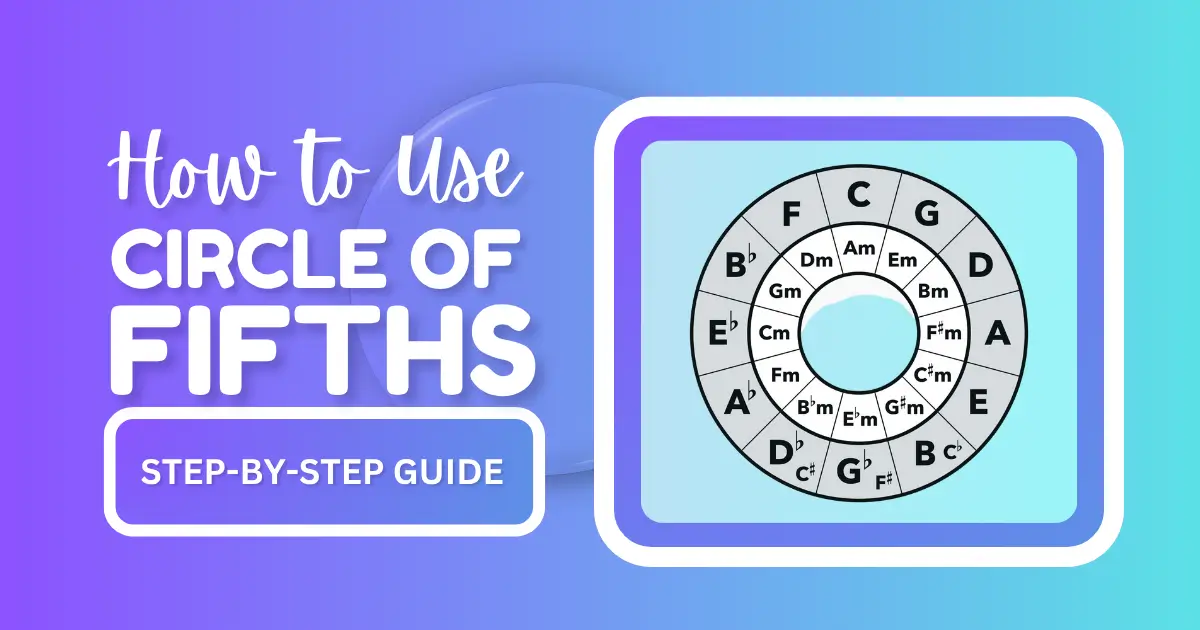
The Circle of Fifths is a circular diagram that represents all 12 major and minor keys in music. It’s arranged in a way that shows you how each key is related to the next by intervals of perfect fifths.
- Clockwise movement: Moving to the right (clockwise) adds sharps to the key signatures.
- Counterclockwise movement: Moving left (counterclockwise) adds flats.
DIAGRAM
How the Circle of Fifths works
Step 1: Understand the Circle Layout (like a clock)
The Circle of Fifths looks like a clock with 12 positions.
Each position represents a key.
Start at the top: C Major is at 12 o’clock (no sharps or flats).
Going clockwise adds sharps.
Going counterclockwise adds flats.
Step 2: Learn the Clockwise Keys (Sharps)
Each move clockwise goes up by a perfect fifth and adds one sharp to the key signature.
Example: Start from note C and count five notes clockwise to locate the note of G.
| Clock Position | Key | Number of Sharps | New Sharp Added |
|---|---|---|---|
| 12:00 | C | 0 | — |
| 1:00 | G | 1 | F♯ |
| 2:00 | D | 2 | C♯ |
| 3:00 | A | 3 | G♯ |
| 4:00 | E | 4 | D♯ |
| 5:00 | B | 5 | A♯ |
| 6:00 | F♯ | 6 | E♯ |
| 7:00 | C♯ | 7 | B♯ |
Trick: Start at C, then keep jumping up a 5th
(C → G → D → A → E → B → F♯ → C♯)
Each time, add 1 sharp to the key signature.
Mnemonics to Remember Circle of Fifths For Sharps :
Come Get Donuts And Eat Breakfast For Coffee
Step 3: Learn the Counterclockwise Keys (Flats)
Each move counterclockwise goes down by a perfect fifth (or up a fourth) and adds one flat.
| Clock Position | Key | Number of Flats | New Flat Added |
|---|---|---|---|
| 12:00 | C | 0 | — |
| 11:00 | F | 1 | B♭ |
| 10:00 | B♭ | 2 | E♭ |
| 9:00 | E♭ | 3 | A♭ |
| 8:00 | A♭ | 4 | D♭ |
| 7:00 | D♭ | 5 | G♭ |
| 6:00 | G♭ | 6 | C♭ |
| 5:00 | C♭ | 7 | F♭ |
Trick: C → F → B♭ → E♭ → A♭ → D♭ → G♭
Each time, add 1 flat to the key signature.
Mnemonics to Remember Circle of Fifths For Sharps :
Can Fred Buy Every Apple During Groceries?
Step 4: Find Relative Minors Inside the Circle
Every major key has a relative minor key with the same sharps/flats. These are usually shown inside the circle.
To find the relative minor of a major key:
- Go three semitones down (a minor third)
- OR: Use the 6th scale degree of the major scale
| Major | Relative Minor |
|---|---|
| C | A minor |
| G | E minor |
| D | B minor |
| A | F♯ minor |
| E | C♯ minor |
| B | G♯ minor |
| F♯ | D♯ minor |
| F | D minor |
| B♭ | G minor |
| E♭ | C minor |
| A♭ | F minor |
| D♭ | B♭ minor |
| G♭ | E♭ minor |
How to Use the Circle of Fifths to Build Chords
Once you understand how to read the Circle of Fifths, the real fun begins—making music with it!
Here’s how it helps you build chords that sound great.
Step 1: Pick a Key to Work In
Let’s say you choose C Major (at the top of the circle). That key has no sharps or flats, and its scale is:
C – D – E – F – G – A – B – C
From that scale, you can build a set of chords using each note. These are called diatonic chords.
Step 2: Know the Chords in That Key
Here are the chords built on each degree of the C Major scale:
| Scale Degree | Chord | Type |
|---|---|---|
| 1 | C | Major |
| 2 | Dm | minor |
| 3 | Em | minor |
| 4 | F | Major |
| 5 | G | Major |
| 6 | Am | minor |
| 7 | Bdim | diminished |
Tip: This pattern of major/minor/diminished is the same for every major key!
Step 3: Use the Circle to Find Common Chords
Look at the neighboring keys on the Circle of Fifths. These are closely related and share many of the same chords.
For example, C Major is surrounded by:
- G Major (1 sharp)
- F Major (1 flat)
- A minor (its relative minor)
These nearby keys can borrow chords from each other for richer progressions.
How to Use the Circle of Fifths for Harmony
Harmony happens when two or more notes or chords are played together. In songs, it’s usually the chord progression underneath the melody or background vocals supporting the main tune.
Harmony sounds good when the chords are related—like a family of sounds. The Circle of Fifths shows exactly which chords are closely related.
Step 1: Use the Circle to Find Related Chords & Progressions
Start with your key. Let’s say:
🎵 You’re in C Major (top of the circle).
Now look at the three keys right next to C:
- Left (F Major)
- Right (G Major)
- Inner Circle (A minor, relative minor)
👉 These are your closest harmonic neighbors. They share most of the same notes and chords—so they sound good together!
Step 2: Use I–IV–V for Strong Harmony
In any key, the most basic harmony comes from these three chords:
- I (Tonic) – feels like “home”
- IV (Subdominant) – adds movement
- V (Dominant) – creates tension that wants to resolve
In C Major:
- I = C
- IV = F
- V = G
Put them together, and you have the classic:
👉 C – F – G – C
This is the backbone of TONS of songs.
Step 3: Add More Harmonic Color
Add other diatonic chords (ii, iii, vi) to give your harmony depth:
In C Major:
- ii = Dm
- iii = Em
- vi = Am
These give you options for softer or more emotional harmony.
Example:
C – Am – F – G (I–vi–IV–V)
Sounds smooth and rich—that’s harmony in action!
Step 4: Borrow Chords from Neighbor Keys
This is where the Circle really shines. Look at the adjacent keys (like G or F), and borrow a chord to spice up your harmony.
🎵 In C Major:
- Borrow D major from G (gives a brighter sound than D minor)
- Borrow F minor for a sad twist
- Borrow B♭ major from F
These are called modal interchange chords—they add tension, surprise, or emotion to your harmony.
Step 5: Use the Inner Circle for Minor Key Harmony
If you’re writing in a minor key, use the inner circle. Each minor key lives inside its major key.
🎵 A minor (inside of C major) shares the same notes—but its harmonies feel darker.
Try these in A minor:
- Am – Dm – E – Am (i–iv–V–i)
- Am – C – G – F (borrow from C major)
Step 6: Use Popular Progression Formulas
These patterns work in almost any key. Use the Circle of Fifths to find chords close to your tonic (home key), and try these out:
Common Chord Progressions (With Roman Numerals + Examples)
1. I–IV–V–I
- Basic, powerful, and super common.
- C–F–G–C
- Used in folk, rock, hymns, and early pop.
2. I–vi–IV–V
- The classic 50s progression
- C–Am–F–G
- Try it in G Major: G–Em–C–D
- Feels emotional and hopeful.
3. ii–V–I
- Strong cadence in jazz and worship
- Dm–G–C
- In F Major: Gm–C–F
- It resolves beautifully and sets up new sections.
4. vi–IV–I–V
- Extremely popular in modern music
- Am–F–C–G (relative minor loop)
- Also works in key of G: Em–C–G–D
5. I–V–vi–IV
- Known as the “Axis of Awesome” progression
- C–G–Am–F
- Heard in hundreds of hits
6. I – IV – vi – V
- C – F – Am – G
- Common in ballads and slow jams
- Emotion: tender, expressive
7. I – V – I – V
- C – G – C – G
- Simple but strong; often used in intros or choruses
- Emotion: stable, rhythmic
8. I – IV – I – V
- C – F – C – G
- Great for folk, country, and blues
Experiment and Listen
Try plugging in chords from your key. Use this formula to build your own:
Start → Add contrast → Build tension → Resolve
Example in C Major:
- Start (C) → Contrast (Am) → Tension (G) → Resolve (C)
Or:
- C – Am – Dm – G – C
- This progression adds movement while staying diatonically safe.
Try It in Any Key
Using the Circle:
- Key of G? Use G–Em–C–D
- Key of D? Try D–Bm–G–A
- Key of F? Try F–Dm–Bb–C
Each one follows the same shape—just use the chords in that key.
Explore Modulation Using the Circle of Fifths
Modulation means changing from one key to another in a song. It’s like shifting the musical mood, adding surprise, tension, or energy. The Circle of Fifths makes it super easy to visualize and choose smooth key changes!
1. Modulate to Neighboring Keys
The easiest modulations happen between adjacent keys on the circle. These keys share many common notes and chords, so the shift sounds smooth and natural.
- From C major, you can modulate to:
- G major (1 sharp)
- F major (1 flat)
These are called closely related keys.
Why it works: G and F both share several chords with C (like C, Am, Dm, G, F).
2. Pivot Chord Modulation
Use a shared chord to move from one key to another. This chord acts as a “pivot” that belongs to both keys.
Example: C major → G major
- Pivot chord: D minor (exists in both keys)
- Use a progression like:
- C – Dm – G – D – G
You’ve now “landed” in G major!
3. Modulate Up a Fifth (Key Lifting)
This creates a bright, exciting lift. Used in key changes for choruses or finales.
Example: C major → G major
- Use the dominant (V) chord of the new key to lead in
- Try:
- C – F – G – D – G
Common in: gospel, anthems, and pop climaxes.
4. Modulate to the Relative Minor or Major
Every major key has a relative minor (and vice versa) on the inner circle.
- C major → A minor
- G major → E minor
Same key signature, different tonal feel.
Example:
- C – Am – Dm – G – E – Am
- It feels like the mood has shifted—more emotional or dramatic.
5. Jump Across the Circle (Tritone Modulation)
Want your music to really surprise listeners? Try jumping directly across the circle.
- C major → F♯ major
- These keys are a tritone apart—the most distant relationship on the circle.
This kind of shift sounds shocking or cinematic. It’s rare in pop but common in jazz, musicals, or experimental music.
Example Progression:
- C – G – F – [suddenly jump to] D – Bm – F♯
6. Use Chromatic Modulation
This is a bold key change using chords that don’t naturally fit together—often with half-step motion.
Example:
- C – Am – F – [Ab – Db – Gb]
It breaks the “rules” but creates rich emotional contrast. The circle helps you map the new key and decide what chords to hit once you’re there.
7. Chain Modulations
This is like climbing up the circle step by step—but doing it quickly or mid-phrase.
Example:
- C → G → D → A → E
You can modulate a little at a time, then land in a totally new key. It sounds adventurous and progressive—great for building intensity.
Apply Harmony in Different Genres
Now that you know how to use the Circle of Fifths for basic harmonic ideas, try applying it to your own music, whether it’s classical, jazz, or contemporary genres. Here’s how you can experiment in different styles:
Pop/Rock:
- Uses I–V–vi–IV a lot
- Example: C – G – Am – F
R&B/Soul:
- More ii–V–I and added 7th chords
- Example: Dm7 – G7 – Cmaj7
Classical:
- Functional harmony with strong cadences (V–I, ii–V–I)
- Modulation through pivot chords
Jazz:
- Lots of ii–V–I and tritone substitutions
- Example: Dm9 – G13 – Cmaj9 → C#7 (modulation)
Cinematic/Video Game:
- Builds tension with key shifts (C → Eb → G)
- Layered harmony for emotion
Download Circle of Fifth Worksheet
Final Takeaway
The Circle of Fifths is a powerful tool that every musician should have in their toolkit. By using it to understand key relationships, build chord progressions, and explore modulations, you’ll be able to create more harmonious and dynamic music.
Ready to take your music to the next level? Start experimenting with the Circle of Fifths today! 🎶 Whether you’re writing a new song, practicing improvisation, or learning new pieces, the Circle of Fifths is your guide to musical harmony.