Imagine being able to recognize the sound of a perfect fifth or build a chord without guessing. That’s the power of understanding music intervals—the invisible threads that hold melodies and harmonies together.
For most beginners, though, intervals can feel like a jumble of numbers and names. But once you grasp the basics, you’ll start to see—and hear—music in a whole new way.
In this guide, we’ll simplify the world of intervals, show you how they work, and give you tools to use them confidently in your music journey.
What Are Intervals in Music?
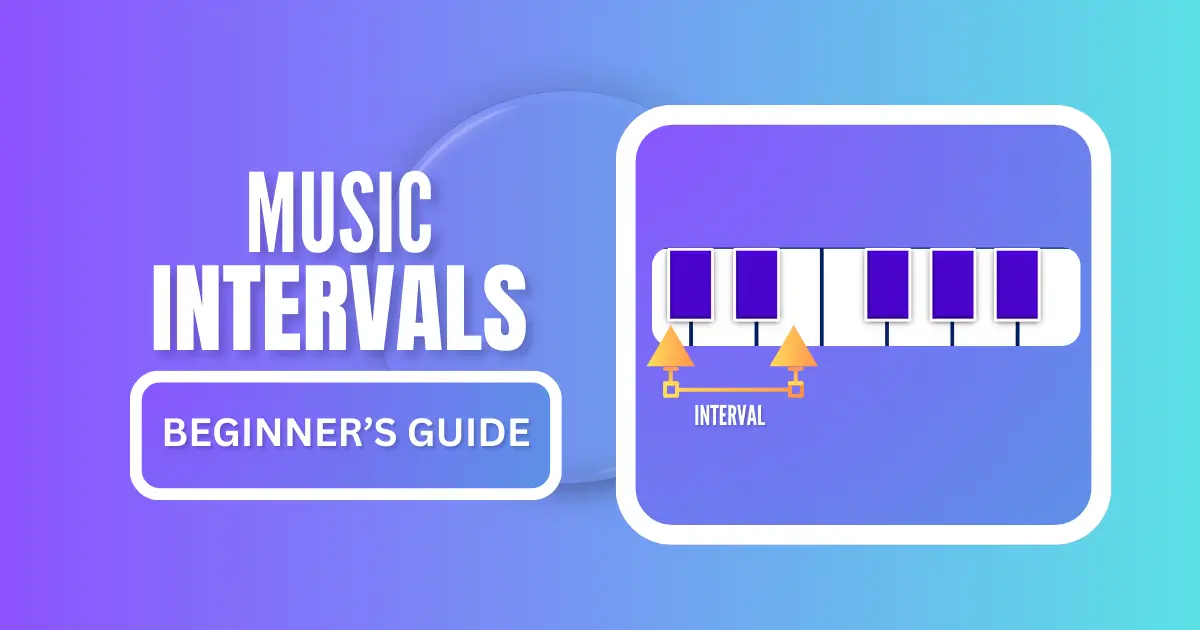
An interval is simply the pitch distance between two notes. Think of playing one note, then another – the gap in pitch is the interval. For example, playing C then E is a “third” interval (4 semitones), while C up to the next C is an “octave” (12 semitones). Intervals can be melodic or harmonic. A melodic interval occurs when notes sound one after the other (like a melody), whereas a harmonic interval is when notes sound at the same time (like a chord).
Music intervals are everywhere—in the chords you play, the melodies you hum, and even the harmonies that give songs their emotional punch. Yet, for many learners, intervals remain one of the most confusing parts of music theory.
Mastering intervals is important: it helps you understand melody and harmony, improve your ear, and build chords. For instance, knowing intervals can improve your sight-reading and aural skills and is vital for composing music.
How to Name and Recognize Music Intervals
To understand intervals, you need to know how to name them. Here’s the process:
- Count the letters: How many note names are there between the two notes?
- Count the semitones: How many half-steps are there between the two notes?
For example:
- From C to D, you have two note names (C, D) and two semitones, which is a Major 2nd.
- From C to E has three note names (C, D, E) and four semitones, which is a Major 3rd.
- From C to E♭ also has three note names (C, D, E), but it has three semitones, which is a Minor 3rd.
Once you know how to name intervals, you can start seeing their pattern in scales, chords, and melodies.
The table below shows common simple music intervals in a C-major context:
| Interval Name | Semitones | Example (C up to…) |
|---|---|---|
| Unison (1st) | 0 | C to C |
| Minor 2nd | 1 | C to C♯/D♭ |
| Major 2nd | 2 | C to D |
| Minor 3rd | 3 | C to E♭ |
| Major 3rd | 4 | C to E |
| Perfect 4th | 5 | C to F |
| Tritone | 6 | C to F♯ (aug.4th) or G♭ (dim.5th) |
| Perfect 5th | 7 | C to G |
| Minor 6th | 8 | C to A♭ |
| Major 6th | 9 | C to A |
| Minor 7th | 10 | C to B♭ |
| Major 7th | 11 | C to B |
| Octave (8th) | 12 | C to (next) C |
For example, C up to C♯ is a minor 2nd (1 semitone), C up to D is a major 2nd (2 semitones), and C to the next C is a perfect octave (12 semitones). These numeric names form the basis of interval classification.
The Most Common Intervals
There are a few key intervals you should know right away:
- Perfect Intervals: Unison, 4th, 5th, and octaves. These are “stable” intervals.
- Major and Minor Intervals: 2nd, 3rd, 6th, and 7th. Major intervals sound brighter, and minor intervals are slightly darker.
- Augmented and Diminished: These are variations of the major or perfect intervals, altered by a half-step.
Let’s expand on this music intervals in depth.
Perfect Intervals: The Foundation of Stable Sound
In music theory, perfect intervals are those that sound especially stable, consonant, and harmonious. These intervals have been used for centuries in Western music to build some of the most essential and pleasing harmonies. They’re called “perfect” because they are inherently stable, and they don’t create tension or dissonance like some other intervals do.
Types of perfect intervals
There are four main types of perfect intervals: unison, perfect fourth, perfect fifth, and octave. Let’s break them down, with examples:
1. Perfect Unison (P1)
A unison occurs when two notes are the same pitch. It’s technically a “distance of zero,” meaning there’s no space between them. It’s often used to emphasize a note or in unison singing or playing.
- Example:
- Playing two C notes on the piano at the same time, or singing the same pitch in a choir. Both notes are in perfect harmony, as they are exactly the same.
While it might sound simple, unisons are often the foundation of a chord or melody, especially when musicians play or sing together to create unity.
2. Perfect Fourth (P4)
A perfect fourth is the distance between two notes that are four letter names apart and five semitones apart. This interval is called “perfect” because of its stable, harmonious quality, even though it’s slightly more open than a unison or octave.
- Example:
- From C to F (C-D-E-F) is a perfect fourth. On the piano, if you start on C and count up four keys (C, D, E, F), you’ll land on the note F.
The perfect fourth is often used in harmonies and can be heard in many folk and classical music pieces. In some contexts, it’s used to create a sense of tension before resolving to a more stable interval like a perfect fifth or octave.
3. Perfect Fifth (P5)
A perfect fifth is one of the most common and recognizable intervals in music. It spans five letter names and seven semitones. The perfect fifth creates a sense of openness and resolution, and it is widely used in harmony and chord construction.
- Example:
- From C to G (C-D-E-F-G) is a perfect fifth. On the piano, if you start on C and count five white keys (C, D, E, F, G), you will land on G.
The perfect fifth is fundamental in creating major and minor chords. In fact, a major chord is made up of the root, the major third, and the perfect fifth. Its stable, consonant sound is a key reason it forms the backbone of much Western music, especially in harmony and chord progressions.
4. Octave (P8)
An octave is the distance between two notes with the same letter name but at different pitch levels. The higher note vibrates at twice the frequency of the lower one, and they sound very similar, but one is perceived as higher. This interval is the most stable of all, and it’s the foundation of scale construction, where each successive note is an octave apart from the last.
- Example:
- From C to the next C (C-D-E-F-G-A-B-C) is an octave. On the piano, if you play C and then jump to the next C up or down, you are playing an octave.
Octaves are incredibly important because they form the basis of scales, and melodies often repeat in octaves. When you hear two notes in an octave, your brain perceives them as similar, even though one is higher than the other.
Perfect Intervals in Practice
Let’s take a closer look at how perfect intervals are used in everyday music.
1. “Twinkle, Twinkle, Little Star” – Perfect Fifth (P5)
One of the simplest and most iconic melodies based on the perfect fifth is the well-known nursery rhyme “Twinkle, Twinkle, Little Star”. The opening line of this melody features a repeating perfect fifth interval between the notes C and G, creating a sweet, familiar sound.
- Example:
- Starting from C, the melody moves to G (C to G, which is a perfect fifth).
- The simplicity of the perfect fifth interval in this tune helps make it memorable and singable for children, and it’s one of the first intervals beginners learn on instruments like the piano or guitar.
2. Beethoven’s “Symphony No. 5” – Perfect Fifth (P5)
In Beethoven’s Symphony No. 5, the famous opening motif “da-da-da-daah” is based on the interval of a perfect fifth. The strong, bold movement between the first two notes (from C to G) creates an unmistakable sense of drive and urgency. This piece is one of the most recognizable examples of the power of the perfect fifth in classical music.
- Example:
- The notes in the famous motif start with a C and move to a G, forming a perfect fifth interval.
- The repetition of this interval throughout the symphony creates both a rhythmic and harmonic stability that builds intensity as the piece progresses.
3. The Beatles – “Hey Jude” – Perfect Fourth (P4)
In The Beatles’ classic hit “Hey Jude,” the chorus features the use of a perfect fourth. When Paul McCartney sings “Na-na-na” over the chord changes, he is often shifting between notes that create a perfect fourth interval. This gives the song a sense of openness and emotional movement.
- Example:
- From C to F (C, D, E, F) is a perfect fourth.
- The use of the perfect fourth interval in the vocal melody creates a dynamic, uplifting feel that complements the song’s message of encouragement and support.
4. Queen – “We Are the Champions” – Perfect Fifth (P5)
Queen’s anthem “We Are the Champions” features a perfect fifth interval prominently in the vocal line. The interval between C and G gives the chorus its soaring, triumphant sound. The perfect fifth is ideal for creating an anthemic, powerful quality, making it the perfect choice for an uplifting song like this.
- Example:
- The melody moves from C to G, forming a perfect fifth.
- The use of this interval in the main line “We are the champions” helps to elevate the overall emotional impact of the song, creating a sense of strength and unity.
5. Star Wars Theme – Octave (P8)
John Williams’ Star Wars Theme is another iconic piece where the octave plays a crucial role. The opening notes of the theme, starting with B and moving to the next B an octave higher, create a heroic, bold sound. The use of the octave interval gives the music an expansive, grand feeling, aligning perfectly with the epic scope of the Star Wars universe.
- Example:
- The first two notes of the Star Wars Theme move from B to B (an octave).
- This octave interval not only signals the beginning of the epic theme but also emphasizes the grandeur and importance of the moment, enhancing the emotional tone of the music.
Table Showing Perfect Intervals in Music
| Interval Name | Abbreviation | Semitones | C-Based Example | Sound Quality | Usage Tip |
|---|---|---|---|---|---|
| Perfect Unison | P1 | 0 | C to C | Identical pitch | Used in doubling melodies or harmony |
| Perfect Fourth | P4 | 5 | C to F | Stable, open, sometimes suspenseful | Common in melodies and counterpoint |
| Perfect Fifth | P5 | 7 | C to G | Strong, consonant | Foundation of power chords and triads |
| Perfect Octave | P8 | 12 | C to C (next octave) | Full, pure, complete | Used for octave harmonies |
Major and Minor Intervals
Major Intervals: bright and cheerful
Major intervals are the musical distances that appear naturally in the major scale. They’re known for sounding bright, happy, and stable—a foundational part of Western music.
The most common major intervals are:
- Major 2nd
- Major 3rd
- Major 6th
- Major 7th
Major Second (M2)
The major second is a distance of two semitones. It’s the interval between two notes that are one full step apart. This interval can feel bright and is often used in simple melodies and scales.
- Example:
- From C to D (C-D) is a major second.
- On the piano, this is the distance between two adjacent white keys. It’s the interval found in scales like the C major scale (C-D-E-F-G-A-B-C), where C to D is a major second.
The major second is often used in children’s songs, folk music, and some pop melodies to create a light, playful effect.
Major Third (M3)
The major third is a distance of four semitones. It is one of the most foundational intervals in music and plays a major role in creating the major chord. A major third gives music a sense of brightness and optimism.
- Example:
- From C to E (C-D-E) is a major third.
- On the piano, if you play C and skip over D, you land on E. This interval is a defining feature of the C major chord.
The major third interval is used in many styles of music, and it’s part of the construction of all major chords. Think of the happy sound in songs like “Do-Re-Mi” from The Sound of Music, which uses major thirds throughout the melody.
Major Sixth (M6)
The major sixth is a distance of nine semitones. It has a warm and pleasant sound and is used frequently in harmony and melody, creating a rich, full effect.
- Example:
- From C to A (C-D-E-F-G-A) is a major sixth.
- On the piano, if you start on C and count up nine white keys, you’ll land on A. This interval is a crucial part of both major and minor chords and scales.
In popular music, the major sixth is used in vocal harmonies and instrumental lines to create an uplifting, hopeful atmosphere.
Major Seventh (M7)
The major seventh is a distance of eleven semitones. This interval creates a sense of anticipation or tension because it is nearly an octave but still leaves something unresolved. The major seventh is often used in jazz and contemporary music to add emotional depth and complexity.
On the piano, you start at C and count up eleven white keys to reach B. This interval is essential in forming major seventh chords, which have a dreamy or jazzy sound.
Example:
From C to B (C-D-E-F-G-A-B) is a major seventh.
Minor Intervals: Dark and Melancholy
A minor interval is a distance between two notes that creates a darker, more somber, or melancholic feel. These intervals are often used in minor scales and chords and are fundamental to creating music with emotional depth and complexity. Minor intervals are typically one semitone smaller than their major counterparts.
Minor intervals can occur between various note combinations, such as the minor second (m2), minor third (m3), minor sixth (m6), and minor seventh (m7).
Minor Second (m2)
The minor second is the smallest interval in Western music, spanning only one semitone. It creates an intense sense of dissonance or tension and is rarely used in melodies, but when it does appear, it has a striking, almost uncomfortable effect.
- Example:
- From C to C♯ (C-C♯) is a minor second.
- On the piano, the notes C and C♯ are adjacent to each other, with only one semitone between them. This interval sounds very sharp and tense.
The minor second is often used in chromatic music or in the horror genre, as it evokes feelings of unease and suspense.
Minor Third (m3)
The minor third is a distance of three semitones. It has a darker and more melancholic sound compared to the major third, and it forms the basis for minor chords, giving music a sense of sadness or mystery.
- Example:
- From C to E♭ (C-D-E♭) is a minor third.
- On the piano, if you start on C and count up three white keys (but skip D and land on E♭), you get a minor third. This interval is essential in the construction of minor chords.
The minor third is found in many sad or reflective songs, like “The House of the Rising Sun”, where the minor chords create an emotional atmosphere.
Minor Sixth (m6)
The minor sixth spans eight semitones. This interval has a sense of darkness or nostalgia and is commonly used in minor keys to express more complex emotions.
- Example:
- From C to A♭ (C-D-E-F-G-A♭) is a minor sixth.
- On the piano, if you start at C and count up eight white keys, you’ll land on A♭. This interval is often used in minor harmony and can be found in jazz and classical pieces that explore more somber or introspective themes.
Minor Seventh (m7)
The minor seventh is a distance of ten semitones. It creates a feeling of tension and yearning, often used to convey more complex, darker emotions. The minor seventh is frequently found in minor seventh chords.
On the piano, you start at C and count up ten white keys to B♭. This interval forms the backbone of many minor seventh chords, commonly used in jazz and soul music.
Example:
From C to B♭ (C-D-E-F-G-A-B♭) is a minor seventh.
Examples in Music
- Major Thirds in Classical Music: The major third is a key component in the construction of major chords and is often used in classical melodies to create a sense of brightness and resolution. For example, in Mozart’s Symphony No. 40, the melody often features major thirds in the string section.
- Minor Thirds in Blues and Jazz: The minor third is commonly used in the blues scale and in jazz to create a melancholic or soulful feeling. Many blues songs, such as “The Thrill is Gone” by B.B. King, rely heavily on minor thirds to express emotional depth.
Here is a table showing the major and minor intervals.
| Interval Name | Notes | Semitones | Sound Description |
|---|---|---|---|
| Major 2nd | C to D | 2 | Light, open (e.g., “Do-Re”) |
| Minor 2nd | C to C♯ | 1 | Tense, close, clashing |
| Major 3rd | C to E | 4 | Bright, happy chord tone |
| Minor 3rd | C to E♭ | 3 | Sad, minor chord tone |
| Major 6th | C to A | 9 | Sweet, singing tone |
| Minor 6th | C to A♭ | 8 | Deep, emotional |
| Major 7th | C to B | 11 | Jazzy, tense, dreamy |
| Minor 7th | C to B♭ | 10 | Warm, soulful |
Try playing these intervals back-to-back on your piano or keyboard. Listen to how one semitone shift changes the emotional impact.
Augmented and Diminished Intervals
In music theory, augmented and diminished intervals are where things start to get spicy. If perfect, major, and minor intervals are the safe roads of music, then augmented and diminished ones are the winding paths that lead to mystery, suspense, and surprise.
Let’s break them down in simple terms.
What Do “Augmented” and “Diminished” Mean?
- Augmented = “increased” → a perfect or major interval raised by one semitone.
- Diminished = “reduced” → a perfect or minor interval lowered by one semitone.
Think of them as altered versions of familiar intervals.
Augmented Intervals
An augmented interval is created when a major or perfect interval is raised by one half step (semitone) without changing the letter names.
- Example:
- C to G = Perfect 5th
- C to G♯ = Augmented 5th
Examples of Augmented Intervals
| Interval Type | Regular Interval | Augmented Version |
|---|---|---|
| Perfect 5th (C–G) | C to G | C to G♯ (Augmented 5th) |
| Major 3rd (C–E) | C to E | C to E♯ (Augmented 3rd) |
| Perfect 4th (C–F) | C to F | C to F♯ (Augmented 4th) |
Diminished Intervals
A diminished interval is created when a minor or perfect interval is lowered by one half step (semitone) without changing the letter names.
- Example:
- C to G = Perfect 5th
- C to G♭ = Diminished 5th
Examples of Diminished Intervals
| Interval Type | Original Interval | Diminished Version |
|---|---|---|
| Perfect 5th (C–G) | C to G | C to G♭ (Diminished 5th) |
| Minor 3rd (C–E♭) | C to E♭ | C to E𝄫 (Diminished 3rd) |
| Perfect 4th (C–F) | C to F | C to F♭ (Diminished 4th) |
Key Rules for identifying augmented or diminished interval
- Only perfect and major/minor intervals can become augmented or diminished.
- You must preserve the letter names—spelling matters!
- C to G♯ is an augmented 5th (not A♭).
- C to A♭ is a minor 6th, not an augmented 5th.
Tip: Though many of these sound like other intervals (enharmonic), the name and function matter—especially in harmonic context or sheet music.
Common Use Cases of augmented & diminished interval
1. The Tritone: Augmented 4th / Diminished 5th
- C to F♯ or C to G♭ — both sound the same.
- Famous for its dissonant, unstable quality.
- Used in:
Horror soundtracks
Blues and jazz (dominant 7 chords contain tritones)
Classical (Liszt, Wagner)
2. Diminished 7th Intervals & Chords
- Found in dim7 chords: C–E♭–G♭–A
- Every interval in a diminished 7th chord is a minor third apart.
- Resolves naturally to major or minor chords — a favorite for modulation.
3. Augmented Intervals in Augmented Chords
Adds tension that begs for resolution.
C–E–G♯ = Augmented triad.
Often used to transition between keys or chords.
Melodic vs. Harmonic Intervals
In music, intervals aren’t just measured by distance—they’re also defined by how they’re played. This leads us to two essential types: melodic and harmonic intervals. Both are vital tools in a musician’s toolbox, but they serve very different purposes.
Let’s dive in and uncover how these intervals work, what they sound like, and where you’ll find them in real music.
What Is a Melodic Interval?
A melodic interval occurs when two notes are played one after another — just like a melody or tune. It’s linear, and you’ll often encounter melodic intervals in vocal lines, solos, or instrument riffs.
Example:
- C followed by E = a melodic major 3rd (played in sequence).
- You hear one note, then the next.
Think of the first two notes of “When the Saints Go Marching In” → C to E — that’s a melodic interval.
Practical Tips
On Piano: Play C, then E = melodic major 3rd.
With Voice: Sing “C – E” as two separate syllables = melodic.
What Is a Harmonic Interval?
A harmonic interval happens when two notes are played at the same time — creating harmony or a chord-like sound.
Example:
- C and E played together = a harmonic major 3rd (played simultaneously).
- You hear both notes at once, producing a richer or more complex sound.
Practice Tips
On Piano: Play C and E together = harmonic major 3rd.
With Voice: Try to hum both together with a friend = harmonic harmony
Think of background vocals or piano chords — those are full of harmonic intervals.
Quick Comparison Table
| Feature | Melodic Interval | Harmonic Interval |
|---|---|---|
| Notes played | One after the other | At the same time |
| Common use | Melody lines, solos | Harmony, chords |
| Sound quality | Sequential, flowing | Vertical, full |
| Example (C to E) | C then E (Major 3rd) | C and E played together (Major 3rd) |
| Visualization (Piano) | Play one key, then another | Press two keys at once |
| Visualization (Guitar) | Pick one note, then another | Strum two strings at once |
Understanding the Role of Intervals in Chords
Intervals are the core building blocks of chords. Every time you play a chord, you’re stacking intervals. A C major chord, for instance, is made of:
- C to E: Major 3rd
- E to G: Minor 3rd
- C to G: Perfect 5th
In music, the emotional character of a chord comes from the intervals between its notes. Whether it’s a major or minor chord, the intervals define whether the sound is bright or melancholic.
How to Build Chords with Intervals
- Start with the Root: The root note is the foundation of the chord.
Choose your root note. For a C major chord, start with C. - Add the 3rd:
- For a Major chord: Go 4 half steps (C to E).
- For a Minor chord: Go 3 half steps (C to E♭).
- Add the 5th:
Move 7 half steps from the root (C to G).
You now have a C major chord (C – E – G).
Common Chords and Their Interval Structures
| Chord Type | Intervals |
|---|---|
| Major | Major 3rd + Minor 3rd (C – E – G) |
| Minor | Minor 3rd + Major 3rd (C – E♭ – G) |
| Diminished | Minor 3rd + Minor 3rd (C – E♭ – G♭) |
| Augmented | Major 3rd + Major 3rd (C – E – G♯) |
Interval Inversions
Inversions refer to rearranging the notes of a chord so that different notes of the chord are in the bass. This technique is essential for creating smooth chord progressions and adding variety to the harmony. Understanding inversions will help you enhance your playing and give your music a richer, more dynamic texture.
What Are Interval Inversions?
An inversion happens when you take a chord and move the root note to a different octave, putting a different note of the chord in the bass. The intervals between the notes stay the same, but their arrangement changes.
Types of Inversions
- Root Position
The chord is in root position when the root note is at the bottom of the chord.- Example: C major chord (C – E – G)
- 1st Inversion
The 3rd of the chord is in the bass.- Example: C major 1st inversion: E – G – C
- 2nd Inversion
The 5th of the chord is in the bass.- Example: C major 2nd inversion: G – C – E
Pro Tips: A three note chords has two inversions – 1st and 2nd inversion.
Practical Steps to Recognize Intervals by Ear
Train your ears to hear music more deeply and confidently
Developing your ability to recognize intervals by ear is a game changer. It helps you play melodies by ear, improvise more naturally, and become fluent in the language of music. The good news? Anyone can learn this with the right approach—no “perfect pitch” required.
Here’s a simple, practical roadmap to get your ears tuned in.
Step 1: Use Songs You Already Know
One of the easiest ways to start hearing intervals is by connecting them to familiar melodies.
Think of this as attaching a sound to a memory.
| Interval | Song Anchor |
|---|---|
| Minor 2nd (m2) | “Jaws” Theme |
| Major 2nd (M2) | “Happy Birthday” (Ha-ppy) |
| Minor 3rd (m3) | “Greensleeves” or “Hey Jude” |
| Major 3rd (M3) | “When the Saints Go Marching In” |
| Perfect 4th (P4) | “Here Comes the Bride” |
| Perfect 5th (P5) | “Twinkle Twinkle Little Star” |
| Minor 6th (m6) | “The Entertainer” |
| Major 6th (M6) | “NBC” Chime, “My Bonnie” |
| Minor 7th (m7) | “Somewhere” (from West Side Story) |
| Octave (P8) | “Somewhere Over the Rainbow” |
Start by singing the first two notes of these songs over and over until the sound of that interval becomes second nature.
Step 2: Train with Apps or Online Tools
Now that you’ve got a few intervals linked to songs, it’s time to test yourself.
Here are some free and effective tools you can try:
- TonedEar.com
- Musictheory.net
- Tenuto (iOS) or Perfect Ear (Android/iOS)
- Perfect Ear (Android/iOS) – versatile app with interval games and drills
Start simple:
- Select 3 intervals (e.g., M2, m3, P4)
- Listen and try to guess the interval
- Get immediate feedback
- Slowly increase your interval set as you improve
This reinforces what you’re learning and keeps your ears honest.
Step 3: Sing and Play the Intervals
Hearing is great. Hearing and singing is better.
- Pick a starting note (like C)
- Sing it
- Try to sing the next note of a target interval (say, E for Major 3rd)
- Check on your instrument to see how close you were
Try doing this both ascending and descending.
Pro Tips: If you’re a pianist or guitarist, isolate those intervals and play them slowly until they feel natural under your fingers and in your ears.
Step 4: Listen to Music Like an Interval Detective
Pick a favorite song and start listening with new ears.
- Can you spot that Perfect 4th?
- Is the chorus jump a Major 6th?
- Hum the two notes and see if it matches one of your anchor songs
Doing this in real-world music sharpens your skills in a way drills can’t.
Step 5: Practice in Small Chunks (Daily)
Just 5–10 minutes a day will do wonders.
- Focus on 2 or 3 intervals at a time
- Use flashcards or interval apps
- Sing them. Hear them. Test them.
Consistency is key. You’re not trying to memorize—you’re trying to internalize.
Step 6: Challenge Yourself with Random Intervals
As you get better:
- Let a friend or app play two notes
- Try to name the interval without any help
- Score yourself and track your progress
You can even try:
- Singing a note (e.g., C)
- Then singing each interval up from there:
C to D (M2), C to E (M3), C to F (P4)… and so on
By mixing these methods (apps, singing, song cues), you’ll improve your interval recognition much faster.
Final Thought
Music intervals might seem tricky at first, but they quickly become second nature with a bit of practice. Try this: pick a simple melody and identify the intervals between each pair of notes. Use the chart above to verify your answers. Practice exercises like daily interval quizzes and keep associating intervals with songs you love.
Ready to take it further? Subscribe to our newsletter (or bookmark this post) for more music theory lessons and free ear-training resources. You can also share your favorite interval trick or ask a question in the comments below – we’d love to hear from you!
Happy practicing, and enjoy exploring the rich world of musical intervals!
Frequently Asked Questions
- What are intervals in music?
Intervals are simply the distance between two pitches. They determine how notes relate in a melody or chord. Intervals can be played melodically (notes in sequence) or harmonically (notes together). - What are the different interval types?
Intervals are named by size (2nd, 3rd, etc.) and quality. Simple intervals within an octave are unison (1st) through octave (8th). In terms of quality: perfect intervals are unison, 4th, 5th, octave; major/minor apply to 2nd, 3rd, 6th, 7th; and augmented/diminished are semitone-altered versions. - What is the difference between melodic and harmonic intervals?
A melodic interval is when two notes are played one after the other (like a melody). A harmonic interval is when two notes sound at the same time (like a chord). - How can I train my ear to recognize intervals?
Consistent practice is key. Use interval ear-training apps or online quizzes daily to drill each sound. Also, associate intervals with songs: for example, think “Star Wars” for a perfect 5th and “Jaws” for a minor 2nd. Over time, you’ll hear intervals instantly. - Why are intervals important in music?
Intervals are the building blocks of all music. They help you construct scales, chords, and melodies. Understanding intervals improves your sight-reading and composition skills, making it easier to analyze music and communicate your ideas on your instrument.