
Have you ever wondered why some pianists sound so smooth when they move from one chord to another? Even when they play simple chords, their music flows beautifully. The secret is in how they use chord inversions.
A chord inversion means turning a chord around by changing which note comes first. Instead of always playing a chord with its root at the bottom, you can move the notes to create new shapes and sounds. This doesn’t change the chord name — it just gives it a different position and feel.
In this post, you’ll learn how chord inversions work, why they’re important, and simple ways to practice them so you can bring that pro-level sound to your own playing.
What Are Piano Chord Inversions?
Let’s start simple. A chord inversion happens when you change the order of the notes in a chord — but keep the same notes.
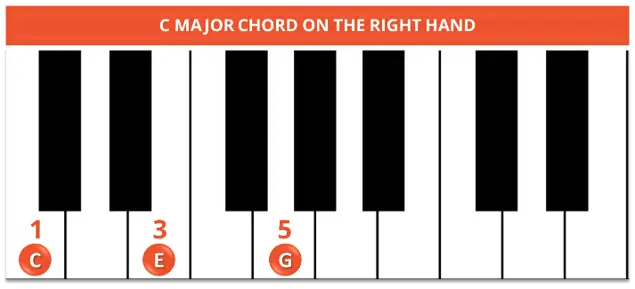
For example, take a C major chord: C – E – G. That’s the root position, because C (the root) is at the bottom.
Now, if you move the bottom note (C) to the top, you get:
E – G – C → that’s the 1st inversion.
Move the next note (E) up, and you get:
G – C – E → that’s the 2nd inversion.
It’s still a C major chord — just rearranged.
Think of it like flipping a sandwich — the ingredients stay the same, but the flavor changes!
Why Learn Chord Inversions?
Chord inversions instantly make your playing sound smoother and more professional. Here’s why:
- Smoother Transitions:
Instead of jumping across the keyboard between chords, inversions help you move just a few notes for seamless progressions. - Fuller Sound:
Inversions let you choose note positions that fill the harmony beautifully — perfect for both solo playing and accompaniment. - Better Voice Leading:
Professional pianists use inversions to make each note “lead” naturally into the next chord.
How to Form Chord Inversions Step-by-Step
Learning to form chord inversions is easier than you think!
Follow these simple steps to master them one by one.
Step 1: Start with a Root Position Chord
To understand how chord inversions work, let’s use the C major chord as a clear example.
The normal (root position) C major chord is made up of C–E–G.
Now, by simply changing the order of these notes, we can create different inversions of the same chord — each with its own sound and feel.
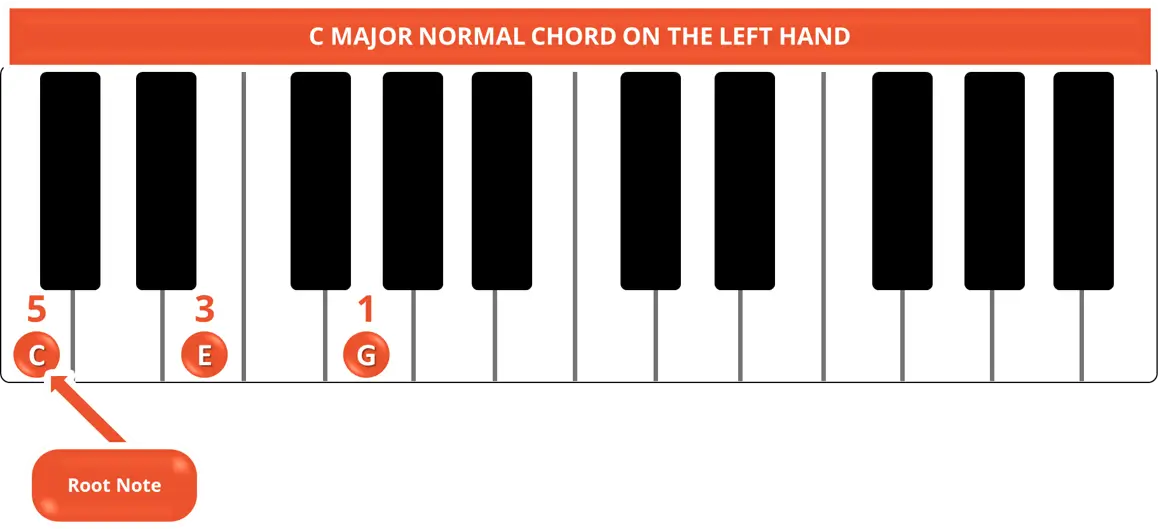
Play the notes in their normal order, with the root at the bottom.
This is your starting point.
- Press C (with your finger 5 also called pinky finger).
- Then press E (with finger 2 also called forefinger).
- Then press G (with finger 3 also called middle finger).
This is the root position. Say: “C E G.”
Left-hand fingering:
- Little finger (5) plays C
- Middle finger (3) plays E
- Thumb (1) plays G
Right-hand fingering:
- Thumb (1) plays C
- Middle finger (3) plays E
- Little finger (5) plays G
Tip:
For the right hand, instead of using 1–3–5, you can try 1–2–5 for smoother movement.
For the left hand, instead of using 5–3–1, you can try 5–2–1 to make transitions easier between chords.
Step 2: Build the First Inversion
Move the lowest note to the top. Order becomes E – G – C.
This is called the first inversion C. It sounds lighter and smoother — great for connecting chords in a progression.
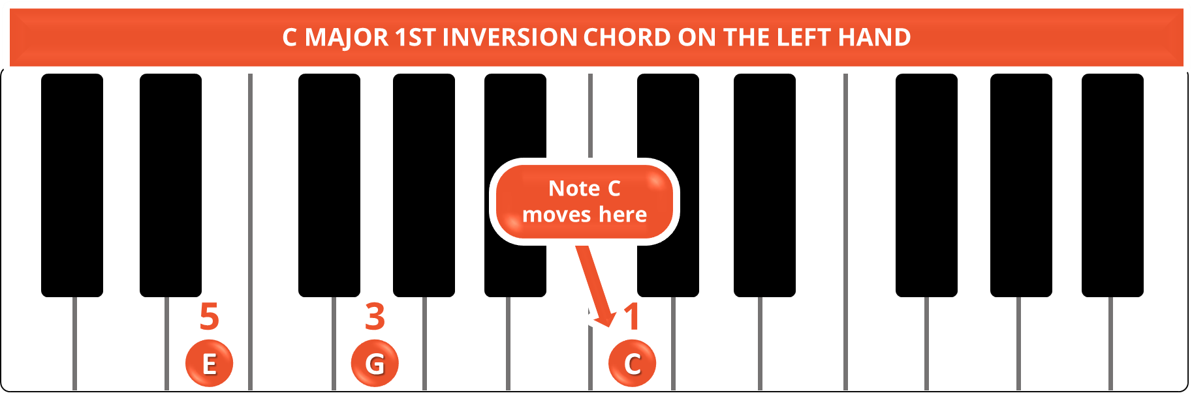
Left-hand fingering:
- Little finger (5) plays E
- Middle finger (3) plays G
- Thumb (1) plays C
Right-hand fingering:
- Thumb (1) plays E
- Middle finger (3) plays G
- Little finger (5) plays C
Step 3: Create the Second Inversion
Move the E (bottom note of the 1st inversion) to the top. Now play G–C–E.
This is called the second inversion. This sounds bright and open — often used before returning to the root position.
New Order: G-C-E.
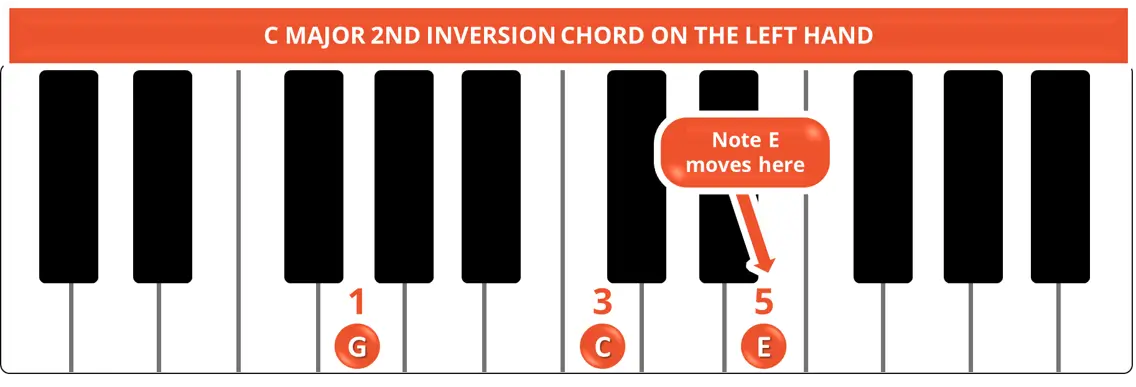
Left-hand fingering:
- Little finger (5) plays G
- Middle finger (3) plays C
- Thumb (1) plays E
Right-hand fingering:
- Thumb (1) plays G
- Middle finger (3) plays C
- Little finger (5) plays E
Common Mistake Alert:
When learning chord inversions, many students make small errors that can slow down their progress. Watch out for these common ones — and fix them early!
Lifting fingers too high
- Keep your fingers close to the keys.
- Smooth transitions come from small movements, not jumping hands around.
Forgetting the chord name stays the same
- Whether you play C–E–G, E–G–C, or G–C–E, it’s still C major, not a new chord!
Using wrong fingering
- Don’t always stick to 1–3–5.
- Try 1–2–5 (right hand) or 5–2–1 (left hand) for easier shifts between inversions.
Playing too fast
- Learn slowly first.
- Make sure every note sounds clear before increasing speed.
Not watching note patterns
- Notice how each inversion moves the bottom note to the top.
- This helps you understand the logic, not just memorize shapes.
Ignoring the sound
- Listen carefully to how each inversion feels — root (strong), first (light), second (bright).
- Training your ear matters as much as training your fingers.
Step 4: Practice Inversions in a Progression (H3)
Common Major Chord Inversions
C, G, and F Major
These chords can also be refers to as Major triad. A three note chord is called Triad.
C Major
Root: C-E-G
1st Inversion: E-G-C
2nd Inversion: G-C-E
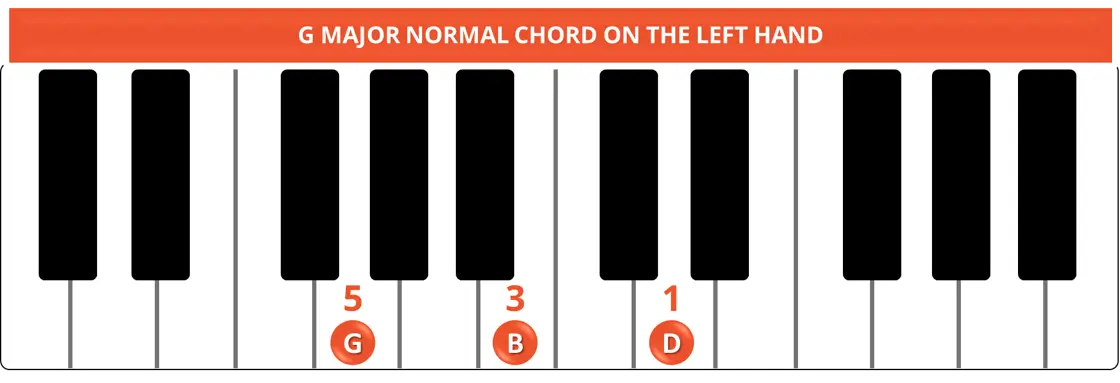
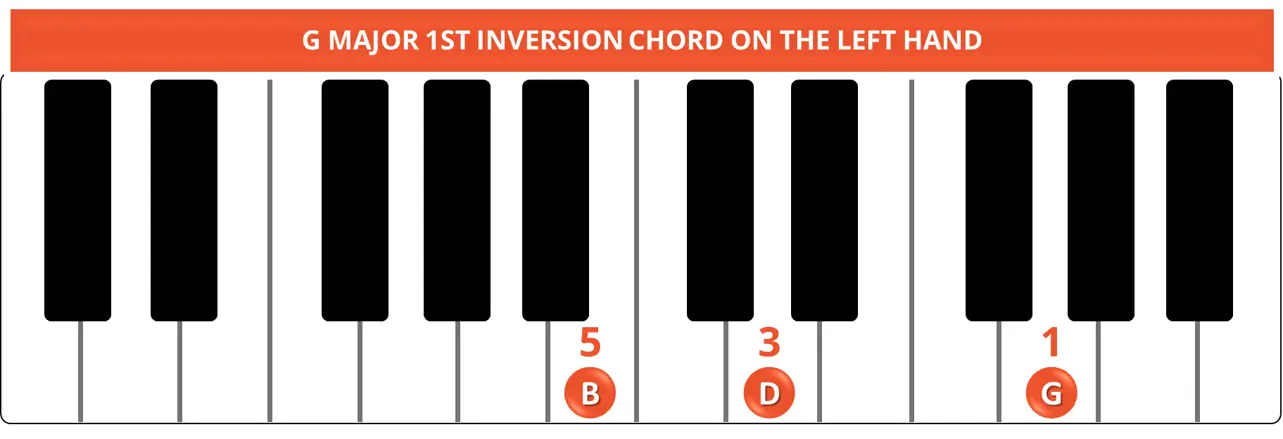
G Major
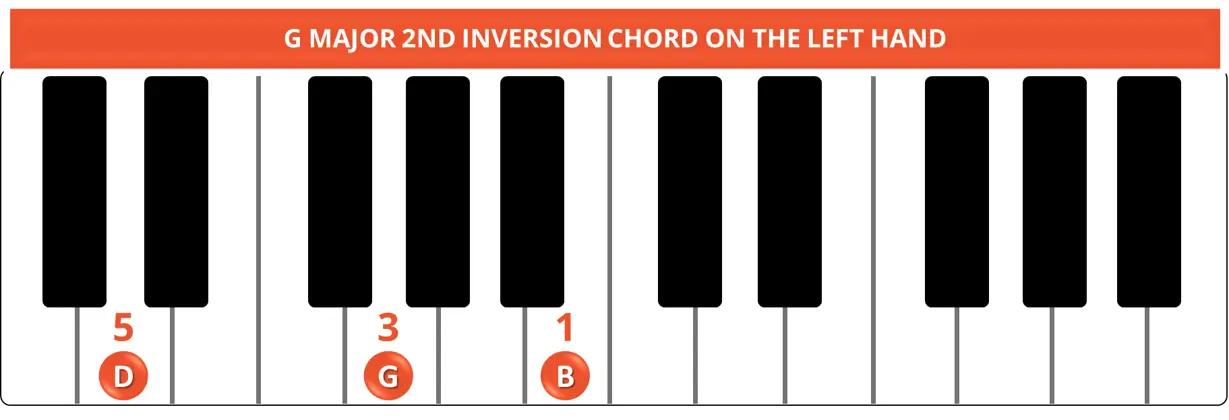
Root: G-B-D
1st Inversion: B-D-G
2nd Inversion: D-G-B
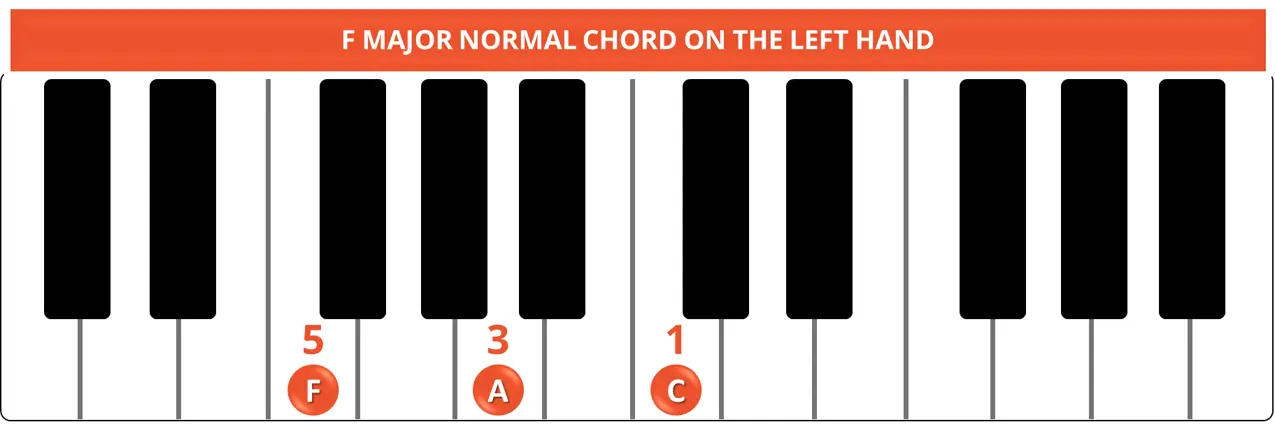
F Major
Root: F-A-C
1st Inversion: A-C-F
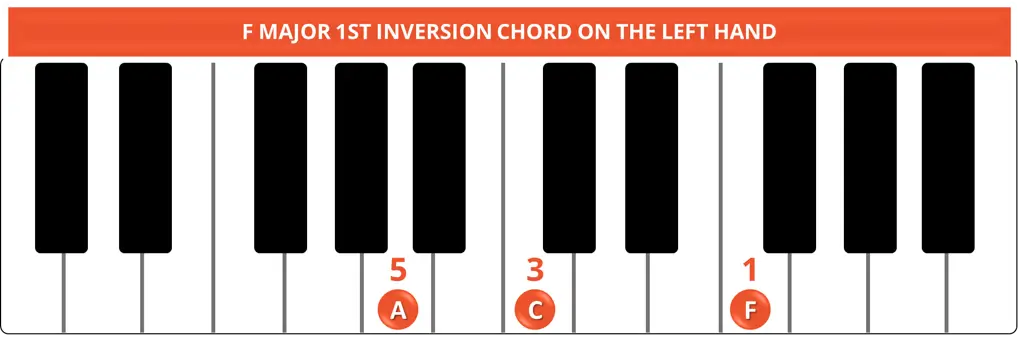
2nd Inversion: C-F-A
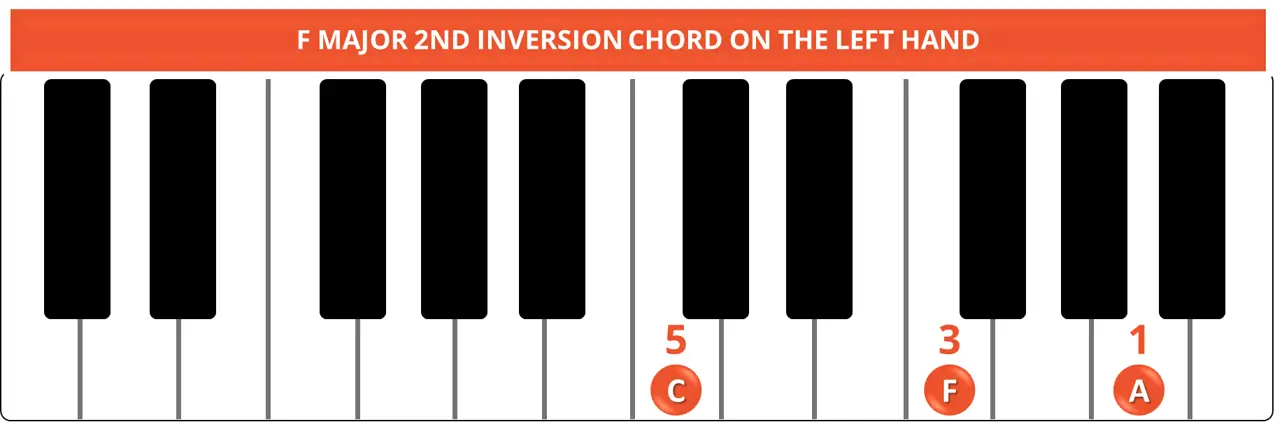
Why practice these? These keys are foundational for beginners and appear in many songs (e.g., pop, classical)
Common Minor Chord Inversions
A Minor and D Minor
A Minor
Root: A-C-E
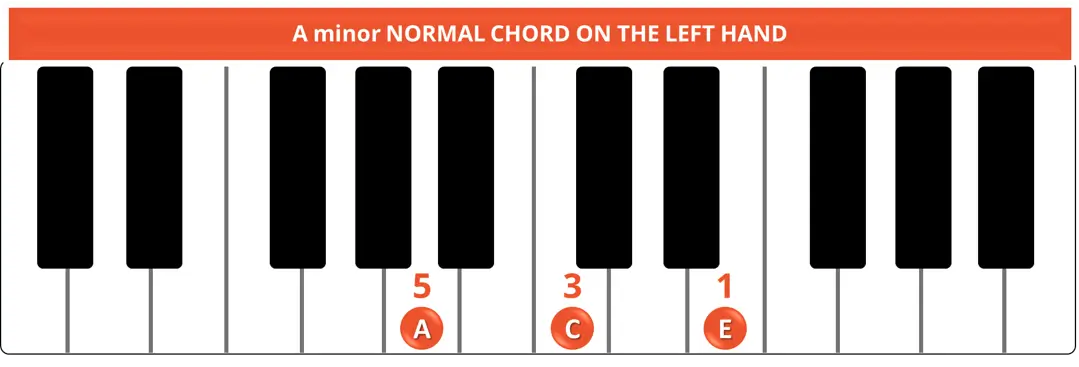
1st Inversion: C-E-A
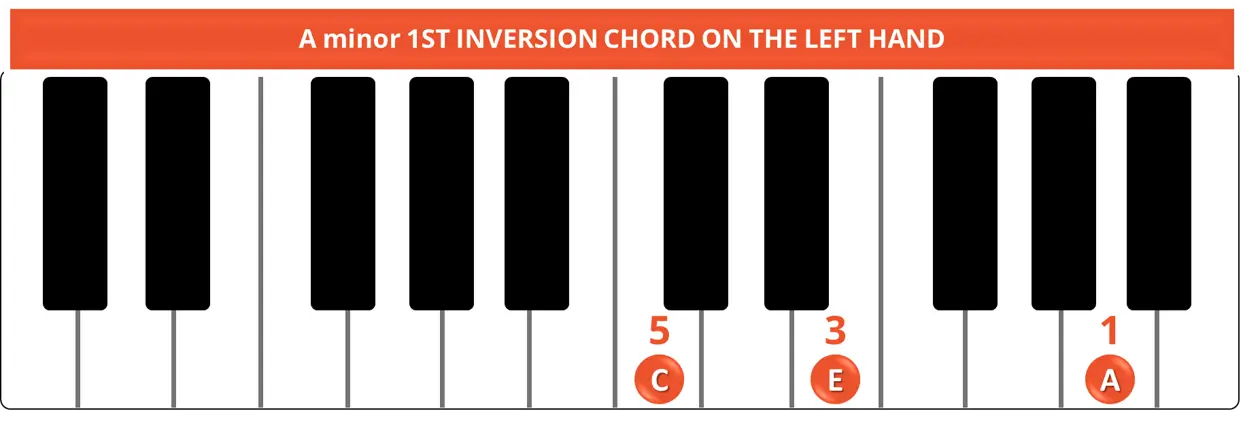
2nd Inversion: E-A-C
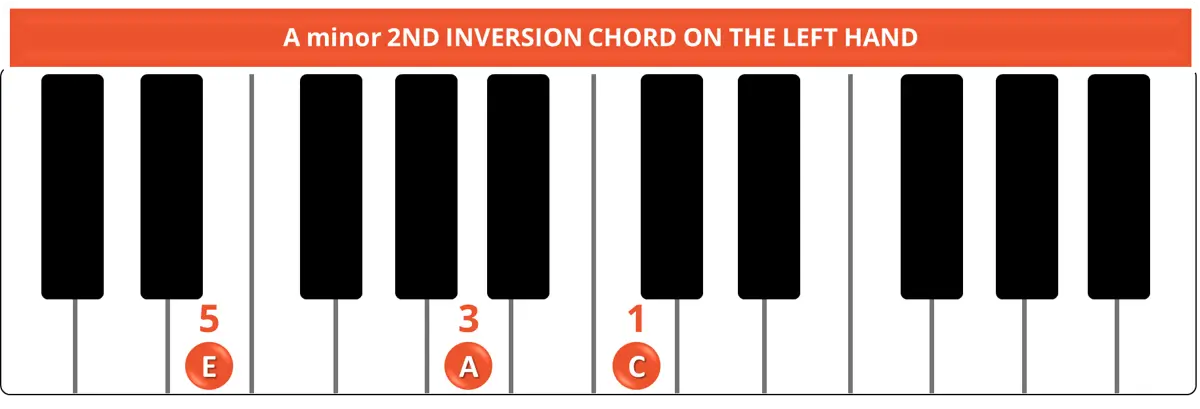
D Minor
Root: D-F-A
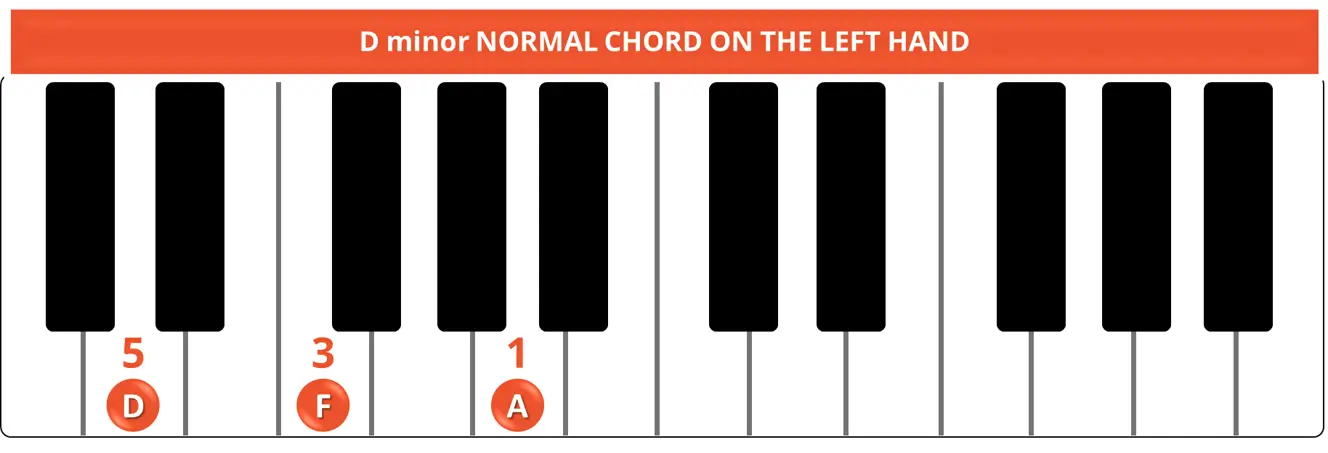
1st Inversion: F-A-D
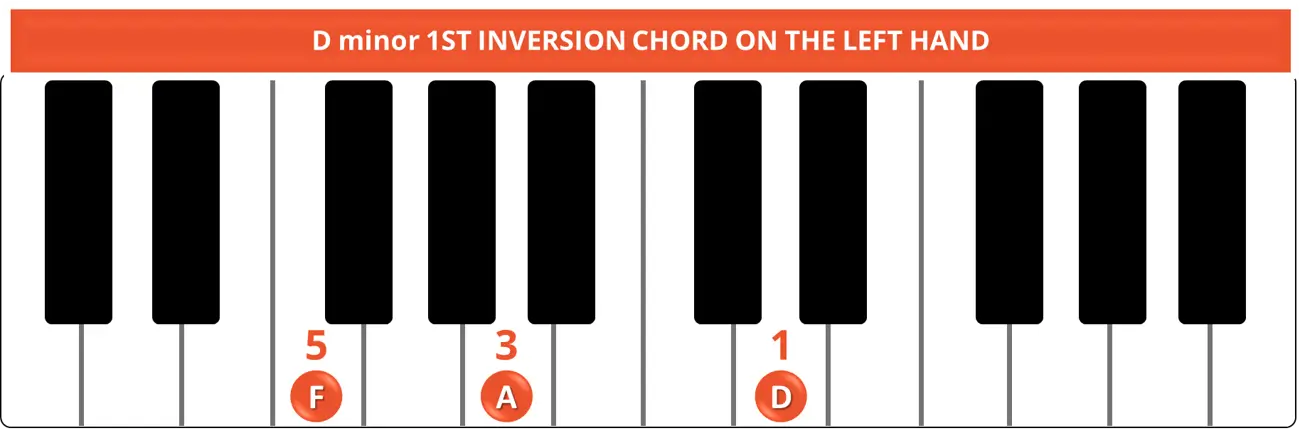
2nd Inversion: A-D-F
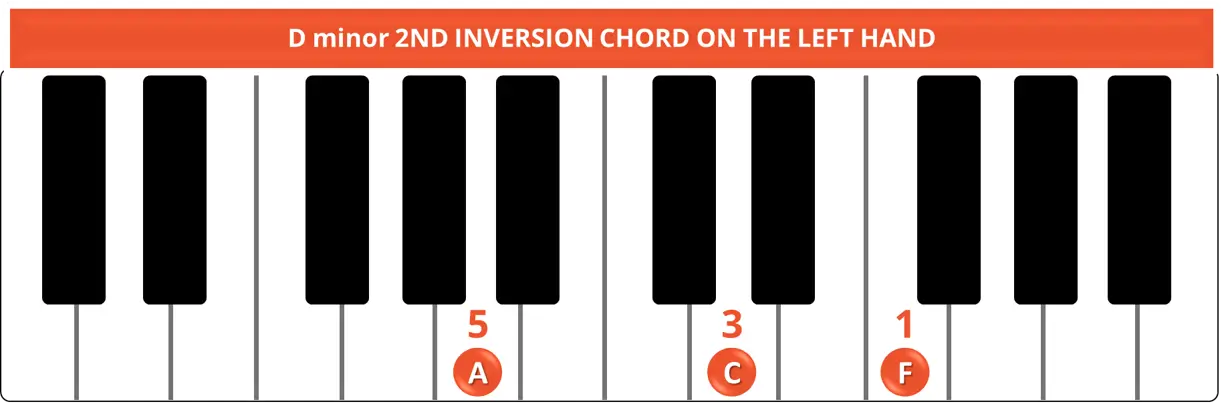
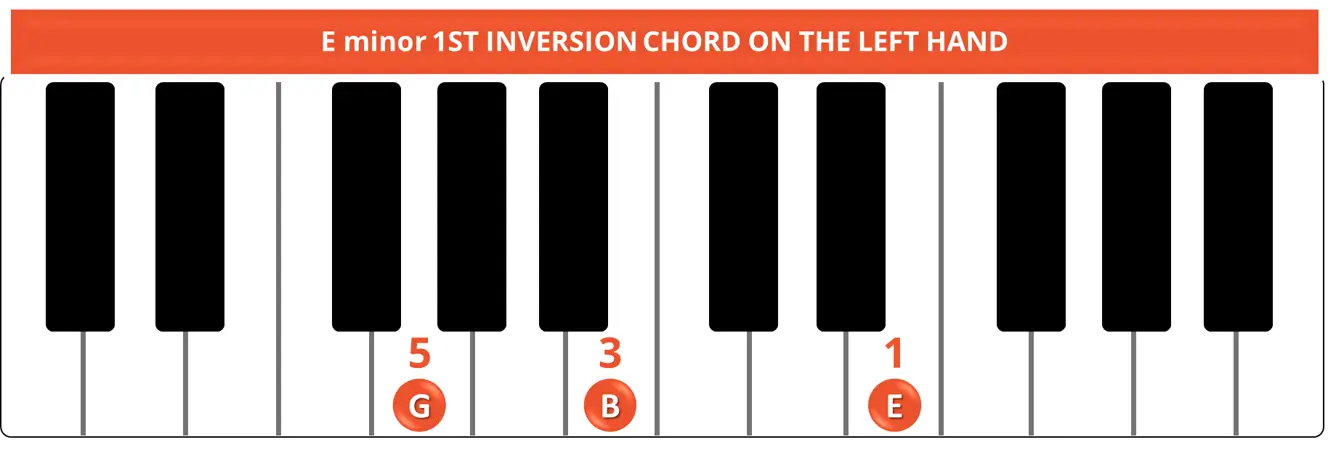
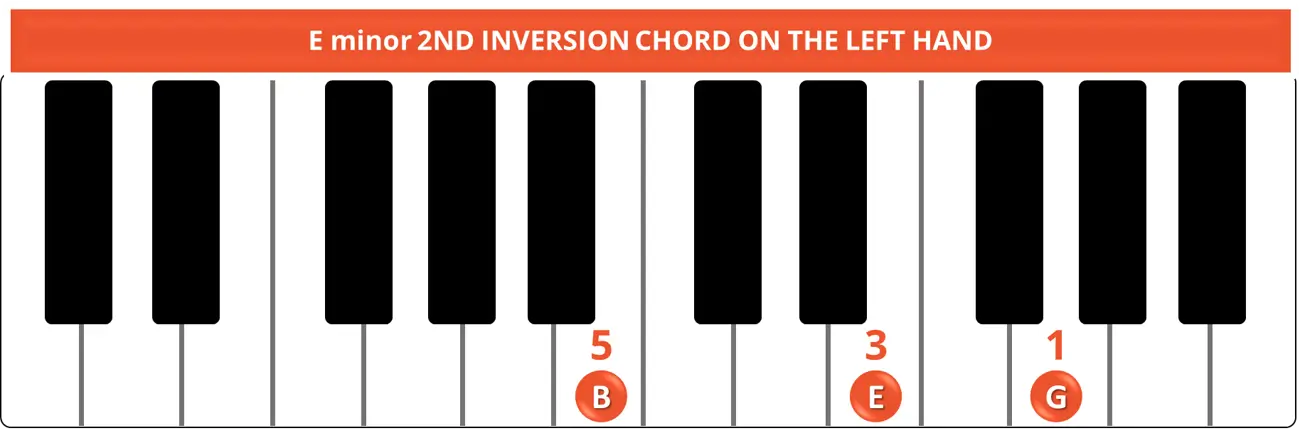
E Minor
Root: E-G-B
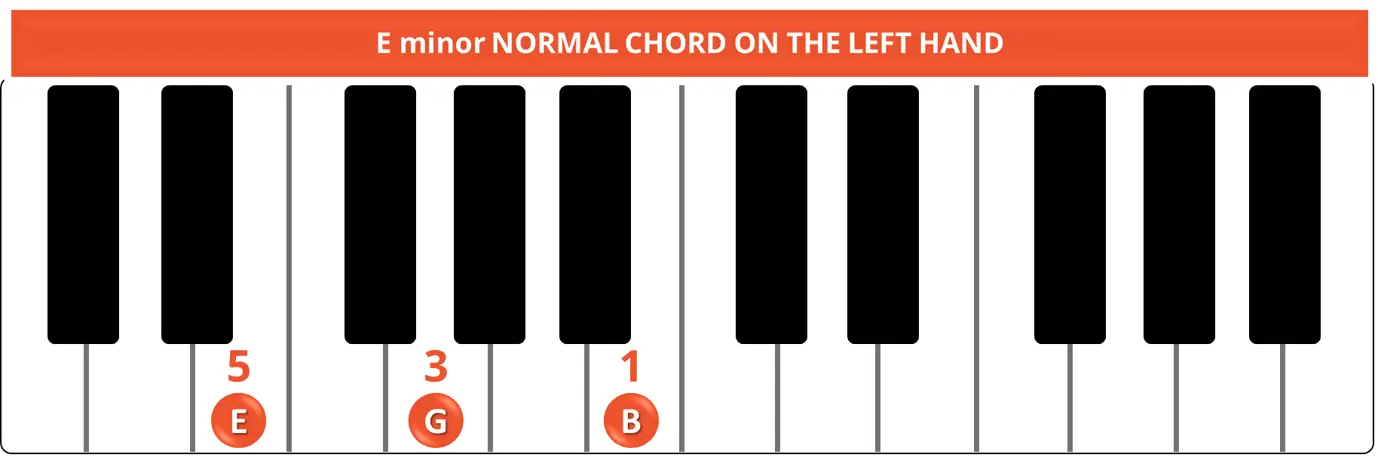
1st Inversion: G-B-E
2nd Inversion: B-E-G
Application: Minor inversions add emotional depth, as heard in songs like Adele’s Someone Like You
Extended Chords (7th Chords)
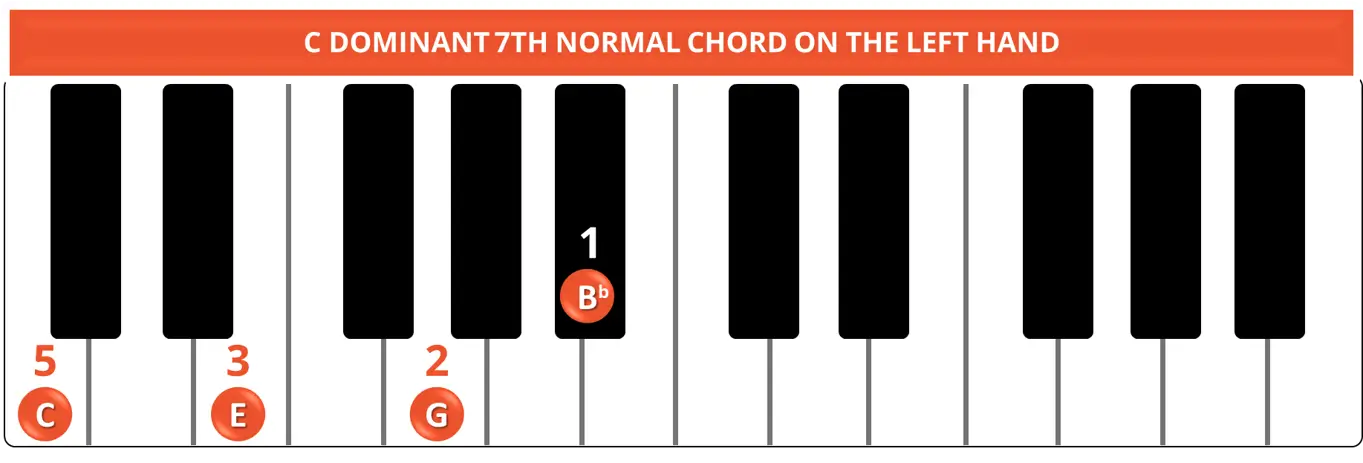
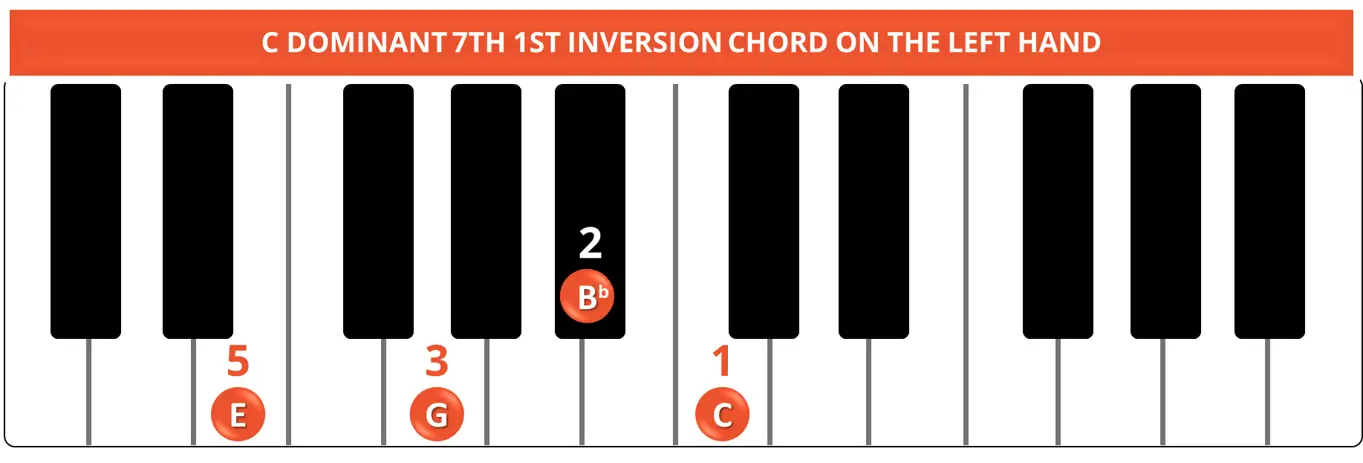
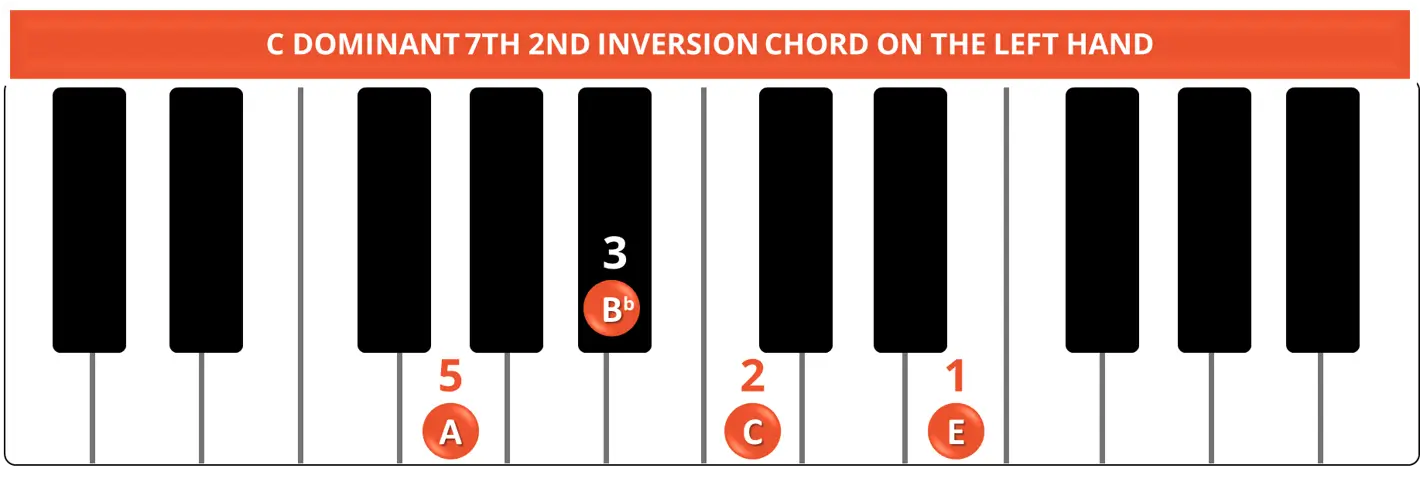
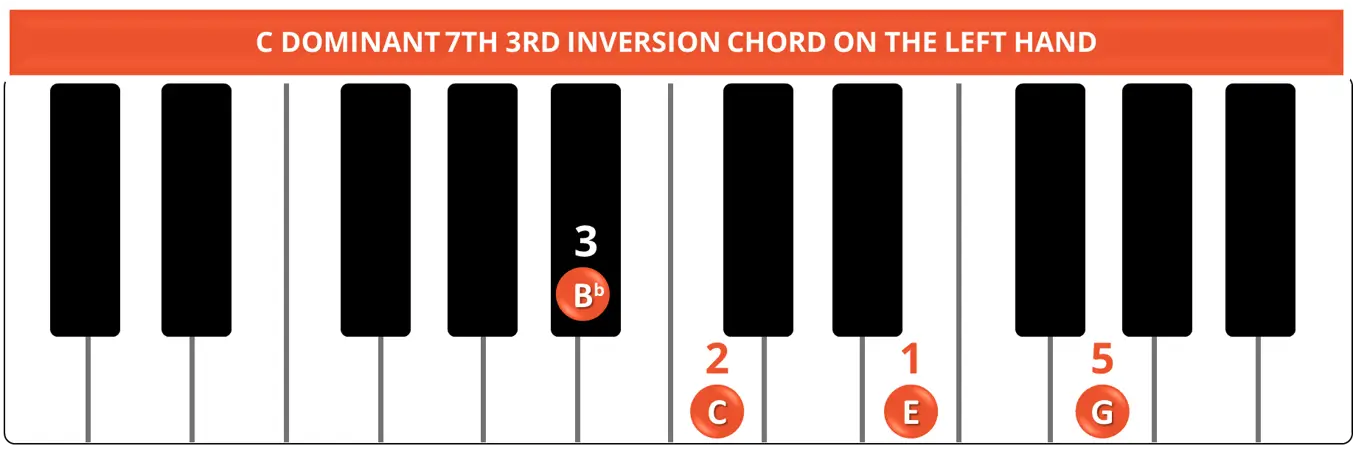
C7 (C Dominant 7th)
Root: C-E-G-B♭
Inversions: 1st: E-G-B♭-C
2nd Inversion: G-B♭-C-E
3rd Inversion: B♭-C-E-G
G7 (C Dominant 7th)
Root: G-B-D-F
Inversions: 1st: B-D-F-G
2nd Inversion: D-F-G-B
3rd Inversion: F-G-B-D
Use Case: Jazz and blues often use 7th inversions for richer harmonies
Practicing Chord Inversions
Now that you know how to form chord inversions, it’s time to put them into practice! Regular practice will help you move between chords easily and make your playing sound more professional and connected.
1. Play Up and Down
Start with one chord, like C major (C–E–G).
Play all its inversions in order:
C–E–G → E–G–C → G–C–E → C–E–G
Then go back down again:
C–E–G ← E–G–C ← G–C–E ← C–E–G
Do this slowly until it feels easy and smooth.
2. Count Steadily
As you play, count 1–2–3–4 for each inversion.
Don’t rush! Let every note sound clear before moving on.
3. Use Both Hands
- Right hand: play the chord in normal order.
- Left hand: play the same inversion one octave lower.
This helps you develop hand coordination and balance.
4. Try Other Chords
After C major, practice the same with F major and G major.
You can also explore A minor to see how minor inversions sound.
Pro Tip: Practice these for 5 minutes daily. Small, steady practice builds muscle memory and gives your playing that “pro” flow.
Chord Transition Drills
Chord transition drills help you move smoothly between chords using inversions.
They train your hands to find the closest notes instead of jumping around the keyboard.
Let’s practice moving smoothly between two chords using inversions. These simple drills will help your hands feel more relaxed and make your playing sound more connected.
Use a metronome at 60 BPM → increase by 5 BPM weekly.
Progression 1: C → F
- C major (Root): C–E–G
- F major (1st inversion): A–C–F
Start with your right hand first.
Play the chord repeatedly with a steady beat.
Use a short, rhythmic bounce — like this: C–C–C–C (count “1–2–3–4”).
And repeat the same bounce for F major.
- Vamp on C major (root) four times.
- Move to F major (1st inversion) four times.
Think of it as tapping your foot and playing along with it.
Right hand
- C major: 1–3–5 (C–E–G)
- F major (1st inversion): 1–3–5 (C–F–A)
Left hand
- C major: 5–3–1 (C–E–G)
- F major (1st inv): 5–2–1 (C–F–A)
Progression 2: C → F
- C major (Root): E–G–C
- F major (1st inversion): F–A–C
Use your rhythmic bounce to vamp from C major normal chord (4 times) to F major 1st inversion (4 times)
Right hand
- C major: 1–3–5 (C–E–G)
- F major (1st inversion): 1–3–5 (C–F–A)
Left hand:
- C major: 5–3–1 (C–E–G)
- F major (1st inv): 5–2–1 (C–F–A)
Progression 2: C → G
- C major (2nd inversion): G–C–E
- G major (Root): G–B–D
👉 Notice that the note G stays in place — that’s how you make transitions smooth!
Right hand
- G major: 1–3–5 (G–B–D)
- C major (2nd inversion): 1–2–5 (G–C–E)
Left hand
- G major: 5–3–1 (G–B–D)
- C major (2nd inversion): 5–2–1 (G–C–E)
Progression 3: A minor → D minor
- A minor (Root): A–C–E
- D minor (1st inversion): F–A–D
Right hand
- A minor – 1–3–5 (A–C–E)
- D minor (1st inv) – 1–2–5 (F–A–D)
Left hand
- A minor – 5–3–1 (A–C–E)
- D minor (1st inv) – 5–2–1 (F–A–D)
Tip: Keep A as a connecting note between both chords.
Progression 4: F → G → C
This is a common gospel and pop movement.
- F major (Root): F–A–C
- G major (Root): G–B–D
- C major (2nd inversion): G–C–E
Right hand
- F major – 1–3–5
- G major – 1–3–5
- C major (2nd inv) – 1–2–5
Left hand
- F major – 5–3–1
- G major – 5–3–1
- C major (2nd inv) – 5–2–1
Tip: Play this slowly, then try with a rhythm pattern (e.g., 2 beats each).
Progression 5: C → A minor → F → G
A classic “pop” chord loop (I–vi–IV–V).
- C major (Root): C–E–G
- A minor (Root): A–C–E
- F major (1st inversion): A–C–F
- G major (Root): G–B–D
Right hand
- Try keeping C and E steady when possible.
- Use 1–2–5 for smoother changes.
Left hand
- Use 5–3–1 or 5–2–1 depending on comfort.
Tip: Play this loop slowly, then in rhythm — this is the foundation for many songs!
Playing Chord Inversion Arpeggios
Once you’ve learned your chord inversions, it’s time to make them sound more musical by turning them into arpeggios (broken chords).
What Is an Arpeggio?
An arpeggio means playing the notes of a chord one after another, instead of all at once.
It gives your music a flowing, melodic sound — like waves on a piano.
Exercise 2: Inversion Arpeggios
- Play each inversion as a broken chord (ascending/descending):
- C Major: C → E → G → E → C
- F Major: F → A → C → A → F
- G Major: G → B → D → B → G
Pro Tip: Use the “thumb under” technique for seamless arpeggios.
Real-World Application Of Chord Inversion
Play These 2025 Trendy Progressions:
- Pop Ballad (C-F-Am-G):
- C Major (1st inversion): E-G-C
- F Major (2nd inversion): C-F-A
- A Minor (root): A-C-E
- G Major (1st inversion): B-D-G
- Lo-Fi Chord Loop (C-F-G):
- Use inversions to create a relaxed, repetitive groove.
Free Downloadable Resources
- PDF Chord Chart: “C-F-G Major Inversions Cheat Sheet” (with fingerings).
- 10-Minute Practice Video: *“2025 Inversion Workout for Pop & Lo-Fi”* (YouTube link)
Common Mistakes to Avoid
- Death Grip: Keep wrists loose and fingers curved.
- Rushing Tempo: Speed comes after accuracy.
- Ignoring Dynamics: Play softly for control, loudly for confidence.
Q1: Do inversions change the chord name?
No. C major stays C major — no matter which note is at the bottom.
Q2: Are inversions used in all music genres?
Yes — from classical to pop to gospel. They’re universal.
Q3: How do I know which inversion to use?
Choose the one that makes the transition smoothest or fits the emotion you want to create.
Q4: Should I learn inversions before 7th chords?
Yes. Inversions are the foundation — 7th chords build on top of them.
Q5: What’s the best way to master inversions faster?
Pair ear training with muscle memory — play, sing, and recognize them by sound.
Final Takeaway
Chord inversions are the gateway to pro-level piano playing.
They take you from sounding like a beginner pressing chords… to sounding like a musician crafting stories through harmony.
Start small — pick one chord, one inversion, one song.
Repeat it daily, and in a few weeks, your playing will sound smoother, richer, and more expressive.
Because great pianists don’t play more notes.
They play the same notes, better.