Music theory is the backbone of musical understanding, providing the tools to read, compose, and perform music. Whether you’re just starting out or want to refresh your knowledge, understanding the basic principles of music theory will deepen your appreciation of music and improve your skills.
In this guide, we’ll go over the fundamental concepts you should be familiar with as a beginner. These building blocks will help you move forward with confidence in your musical journey.
What is Music Theory?
Music theory is the study of how music works. It covers everything from reading notes on a staff to understanding rhythms, scales, chords, and more. Think of it as the grammar of music. Just like language has rules for how words are put together, music theory provides the rules for how notes and rhythms are structured in a song.
Key Takeaways:
Music theory helps musicians understand and create music.
Here’s what music theory covers at a beginner level:
- Notes and pitch (the building blocks of sound)
- Scales and keys (how notes are grouped)
- Chords and harmony (how notes work together)
- Rhythm and time (how music moves)
- Reading sheet music (learning to understand written music)
Learning music theory won’t take away the creativity—it actually helps you become more creative. Once you understand the rules, you can start bending and breaking them in your own unique way.
Who is a music Theorist?
A music theorist is someone who studies, analyzes, and explains the structure and elements of music. They dive deep into the building blocks of music—like harmony, melody, rhythm, form, and notation—to understand how music works and why it sounds the way it does.
What Does a Music Theorist Do?
- Analyzes compositions to understand their structure and techniques
- Studies scales, chords, and intervals to explain musical systems
- Develops new theories about how music is created and perceived
- Teaches music theory to students or writes academic articles and books
- Collaborates with composers or performers to enhance musical understanding
Where You’ll Find Music Theorists
- Universities and conservatories
- Music publishing companies
- Academic conferences and journals
- YouTube and educational platforms (in modern contexts)
Famous Music Theorists (Past & Present)
- Heinrich Schenker – Known for “Schenkerian analysis”
- Jean-Philippe Rameau – Baroque composer and early theorist on harmony
- Allen Forte – Influential in 20th-century set theory
- Deborah Stein – Specialist in Romantic music analysis
Ready to start with the basics? Let’s talk about the building blocks of music—notes and pitch.
Music Notes, Pitch & Melody: your First Step Into Music
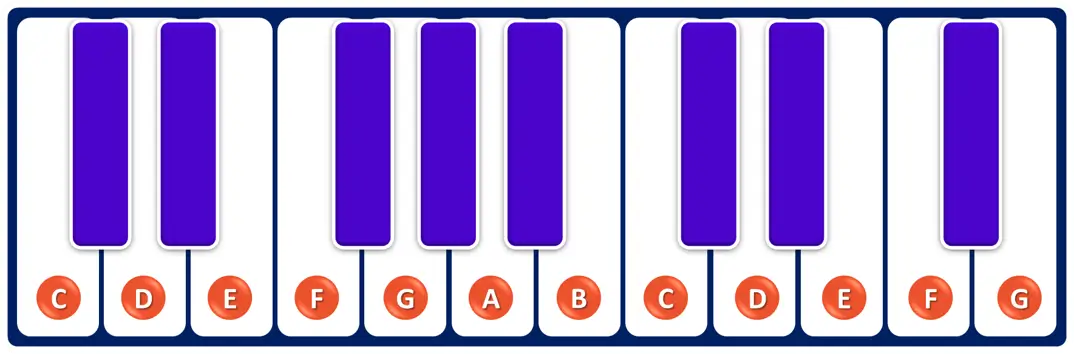
Let’s start at the heart of music—music notes. Think of notes as the letters of the musical alphabet. Each one represents a sound, and when you put them together, you get music.
There are only seven main music notes to remember:
A, B, C, D, E, F, and G
After G, the pattern starts over again at A, just in a higher or lower pitch.
What Is a Pitch?
A Pitch is how high or low a note sounds. Imagine singing a lullaby softly, then suddenly trying to belt out the chorus of your favorite pop song—those are different pitches. And each note on a musical instrument (like a piano or guitar) plays at a specific pitch.
Let’s Talk Piano
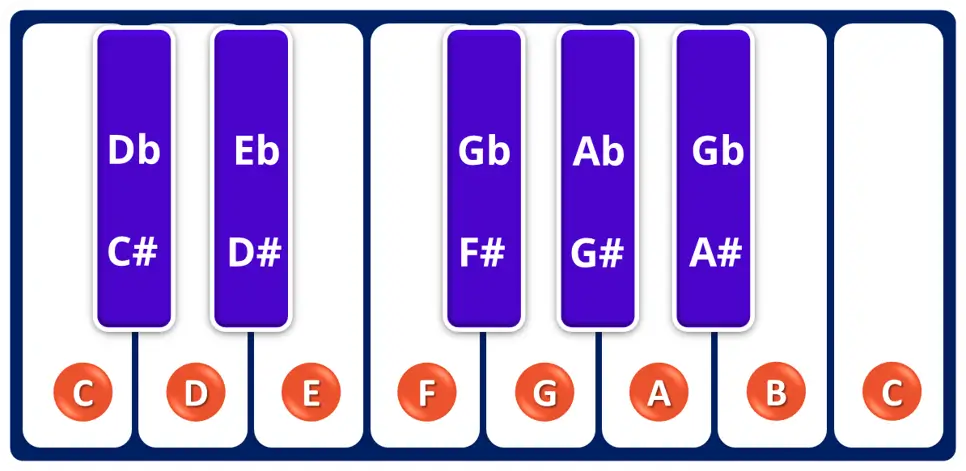
Even if you don’t play piano, it’s super helpful for understanding pitch and notes. The white keys show the main notes (A–G), and the black keys in between are the sharps (♯) and flats (♭).
For example:
- The black key between C and D is either C♯ or D♭—same sound, different names depending on what you’re playing.
- As you move to the right on the keyboard, notes get higher.
- Move left, and the notes get lower.
What Is an Octave?
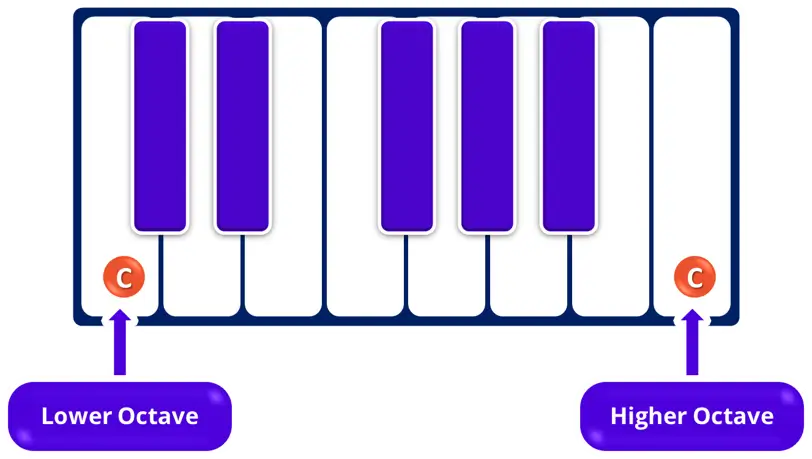
An octave is when the note name repeats but sounds higher or lower. Try singing a low C, then a high C—same note name, but a totally different feel. That’s an octave. Music repeats itself in this pattern, giving it both structure and variety.
What Is a Melody?
A melody is the main tune of a song—the part you usually hum, sing, or recognize instantly. It’s a series of musical notes arranged in a way that’s catchy, expressive, and memorable.
You can think of melody as the “musical sentence” that tells the story. It moves up or down in pitch and often sticks in your head long after the song ends.
Key Features of a Melody
- Pitch – The highness or lowness of each note
- Rhythm – The timing and duration of the notes
- Contour – The shape or direction of the melody (does it go up, down, or stay level?)
- Intervals – The distance between the notes
- Phrasing – Natural groupings of notes, like musical sentences
And that’s the basics of notes and pitch! Next, we’ll dive into Scales, intervals, transposing & Key Signatures. Let’s keep going!
Scales, intervals, transposing & Key Signatures: The Mood Makers of Music
Now that you’ve got the notes and pitch down, it’s time to discuss about scales, transposition, intervals and key signature.
What Are Scales?
A scale is simply a series of notes arranged in ascending or descending order, based on a specific pattern of intervals (the distance between two notes). The most common type of scale is the major scale, but there are many others, including minor scales, pentatonic scales, and more.
Here’s a breakdown of the most important scales:
Major Scale
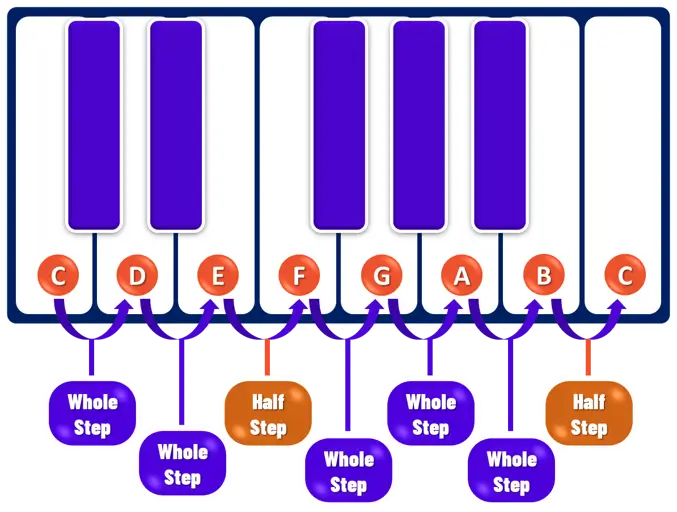
The major scale is often associated with a happy or bright sound. It follows a pattern of whole steps and half steps: Whole, Whole, Half, Whole, Whole, Whole, Half.
Example (C Major): C – D – E – F – G – A – B – C
Natural Minor Scale
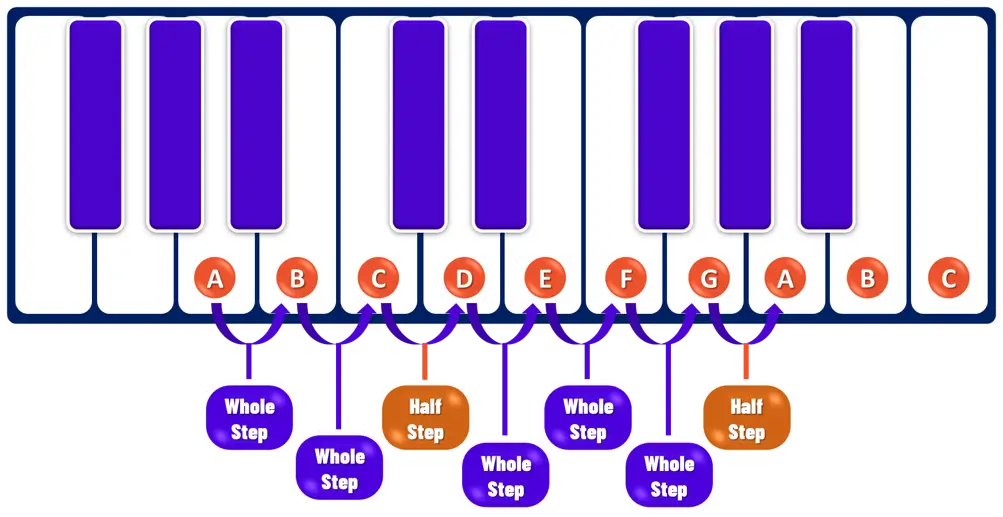
The natural minor scale has a more somber or sad sound compared to the major scale. It follows the pattern: Whole, Half, Whole, Whole, Half, Whole, Whole.
Example (A Minor): A – B – C – D – E – F – G – A
Pentatonic Scale
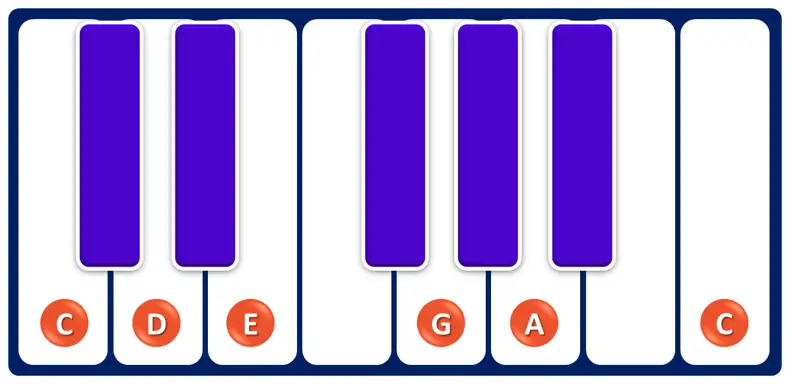
The pentatonic scale consists of just five notes, making it simpler but still very powerful. The major pentatonic scale sounds bright and uplifting, while the minor pentatonic scale sounds more bluesy and introspective.
Example (C Major Pentatonic): C – D – E – G – A – C
What is a Key Signature?
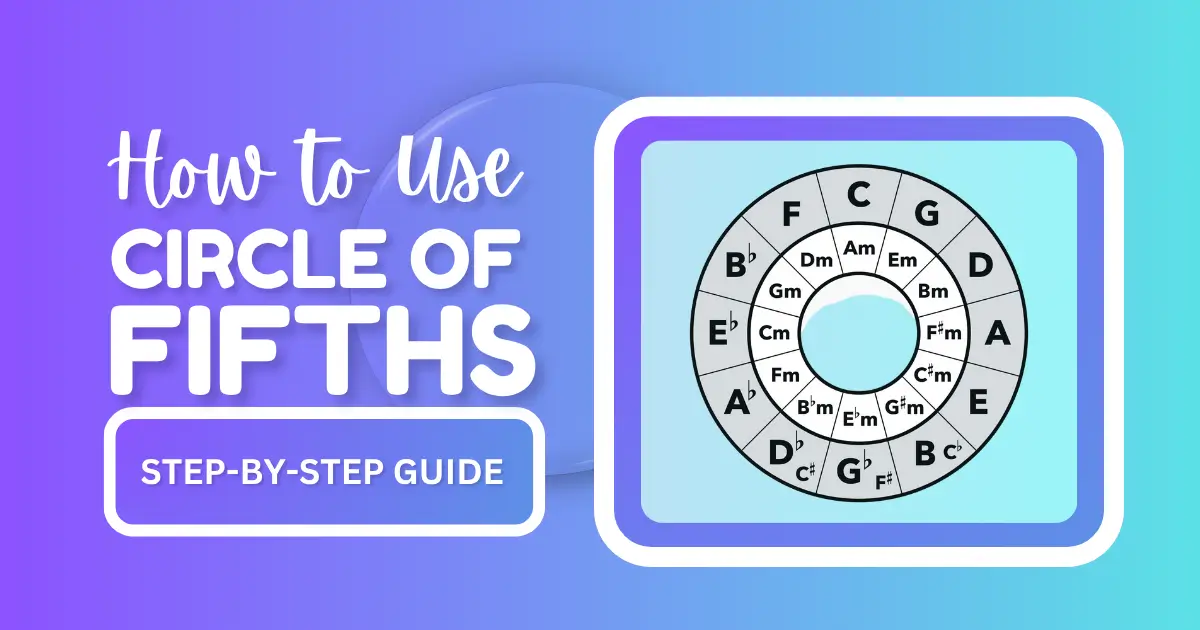
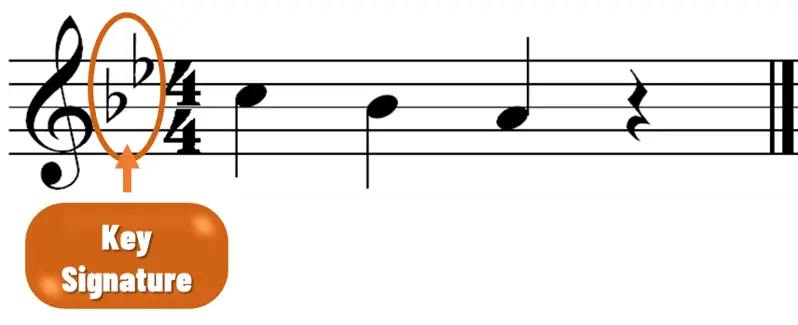
A key signature tells you what scale a piece of music is based on. It also shows which notes are sharp (♯) or flat (♭) throughout the song, so you don’t have to keep writing them in every time.
For example:
- Music in the key of C major has no sharps or flats.
- Music in the key of G major has one sharp: F♯.
- Music in the key of A minor also has no sharps or flats—but it sounds completely different from C major.
Learning key signatures helps you quickly understand the “home base” of any piece of music and sets the tone for everything that follows.
Table showing Major Scales and Their Key Signatures
| Major Scale | Key Signature | Sharps / Flats | Sharps or Flats Present |
|---|---|---|---|
| C Major | No sharps or flats | 0 | – |
| G Major | 1 sharp | ♯ | F♯ |
| D Major | 2 sharps | ♯♯ | F♯, C♯ |
| A Major | 3 sharps | ♯♯♯ | F♯, C♯, G♯ |
| E Major | 4 sharps | ♯♯♯♯ | F♯, C♯, G♯, D♯ |
| B Major | 5 sharps | ♯♯♯♯♯ | F♯, C♯, G♯, D♯, A♯ |
| F♯ Major | 6 sharps | ♯♯♯♯♯♯ | F♯, C♯, G♯, D♯, A♯, E♯ |
| C♯ Major | 7 sharps | ♯♯♯♯♯♯♯ | F♯, C♯, G♯, D♯, A♯, E♯, B♯ |
| F Major | 1 flat | ♭ | B♭ |
| B♭ Major | 2 flats | ♭♭ | B♭, E♭ |
| E♭ Major | 3 flats | ♭♭♭ | B♭, E♭, A♭ |
| A♭ Major | 4 flats | ♭♭♭♭ | B♭, E♭, A♭, D♭ |
| D♭ Major | 5 flats | ♭♭♭♭♭ | B♭, E♭, A♭, D♭, G♭ |
| G♭ Major | 6 flats | ♭♭♭♭♭♭ | B♭, E♭, A♭, D♭, G♭, C♭ |
| C♭ Major | 7 flats | ♭♭♭♭♭♭♭ | B♭, E♭, A♭, D♭, G♭, C♭, F♭ |
Transposing: Changing Keys
Transposing is the act of moving a piece of music from one key to another. Musicians transpose for many reasons:
- To match a singer’s vocal range
- To simplify a piece for easier playing
- To experiment with a different sound or emotion
How to Transpose Music
To transpose, follow these basic steps:
- Identify the original key.
- Determine the new key you want to play in.
- Shift each note (or chord) in the song up or down by the same interval.
For example, if you’re transposing a song from C major to D major (a whole step up), every note moves up by one whole step:
- C becomes D
- D becomes E
- E becomes F♯
- And so on…
You can also use tools like a transposing chart or a keyboard to help you visualize the shift.
Pro Tips: Knowing how to read key signatures and transpose songs gives you flexibility and confidence as a musician
What is an Interval?
Now that we’ve covered the building blocks of music like notes, scales, and key signatures, it’s time to talk about intervals—the distances between notes.
An interval is simply the distance between two notes. It can be measured in different ways, but the most common method is by counting the number of letter names between the two notes, including the starting note.
For example:
- The interval from C to D is a second (C, D).
- The interval from C to E is a third (C, D, E).
- The interval from C to G is a fifth (C, D, E, F, G).
But it’s not just about counting letters—quality matters too. The same interval can sound different depending on how far apart the two notes are. A major interval is a specific type of interval that has a particular sound, and a minor interval is a slightly smaller version.
Types of Intervals:
- Unison: The same note played twice (C to C).
- Second: From one note to the next (C to D).
- Third: A step and a half (C to E).
- Fifth: A perfect fifth (C to G).
- Octave: A note and its duplicate, higher or lower (C to the next C).
Rhythm, Measure and Time Signatures: The Pulse of Music
In every piece of music, there’s a heartbeat. That heartbeat is rhythm—the pattern of beats and timing that drives the entire song forward. Rhythm is crucial because it determines how the music feels. Is it fast or slow? Is it steady, or does it have a swing to it? Let’s break down the basics of rhythm and time signatures so you can understand how music moves.
What Is Rhythm?
Rhythm refers to the timing of notes in music, including how long or short each note is played. Think of rhythm as the motion of the song, the way the music flows in time.
In simple terms:
- Long notes stretch the sound, holding it.
- Short notes create a quick, crisp feeling, moving the music forward.
- Syncopation (playing off-beat) can add an unexpected twist to the rhythm.
What Are Measures in Music?
A measure (also called a bar) is a segment of time in music that contains a specific number of beats, organized by a time signature.
Think of measures like “musical containers” that help organize rhythm into readable chunks.
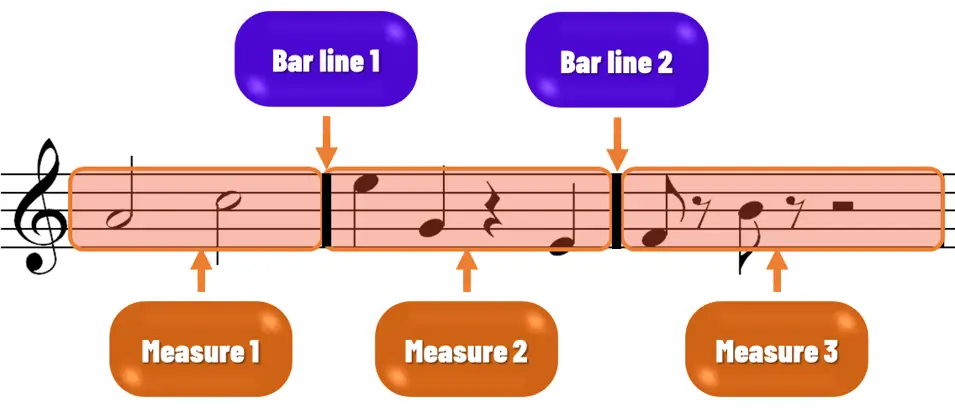
What’s Inside a Measure?
Each measure has:
- A specific number of beats (like 4 beats in 4/4 time)
- Notes and rests that add up to that beat count
- A bar line at the end to separate it from the next measure
What Is a Time Signature?
A time signature is a symbol at the beginning of a piece of music that tells you how many beats are in each measure and what type of note gets the beat. It’s like the blueprint of the music’s rhythm.
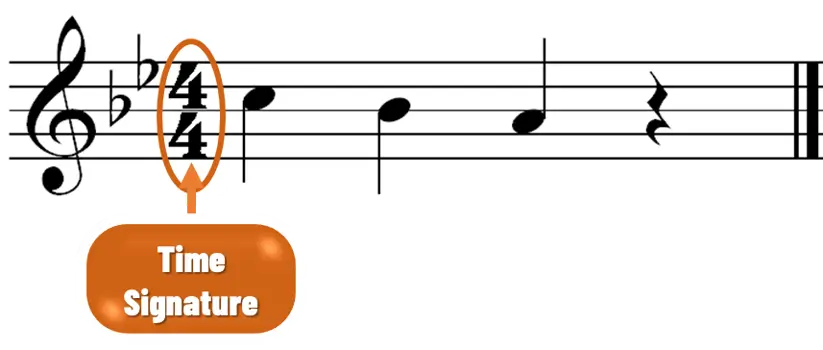
Try clapping or tapping to songs you love and count along. Is it 1-2-3-4? That’s likely 4/4 time. Is it 1-2-3? You’re probably in 3/4. Understanding rhythm and meter helps you feel the music more deeply and stay in sync when playing with others.
The most common time signatures are:
- 4/4: Four beats per measure, with the quarter note receiving one beat. This is the most common time signature in pop, rock, and classical music.
- 3/4: Three beats per measure, with the quarter note receiving one beat. Often used in waltzes or ballads.
- 6/8: Six beats per measure, with the eighth note receiving one beat. This time signature is often used in fast-paced folk music and some rock songs.
Chords and Harmony: Building the Heart of Music
Now that you’re familiar with intervals, it’s time to dive into one of the most exciting and essential parts of music: chords and harmony. These are the elements that give music its fullness and emotion, turning simple melodies into the songs you love.
What Is a Chord?
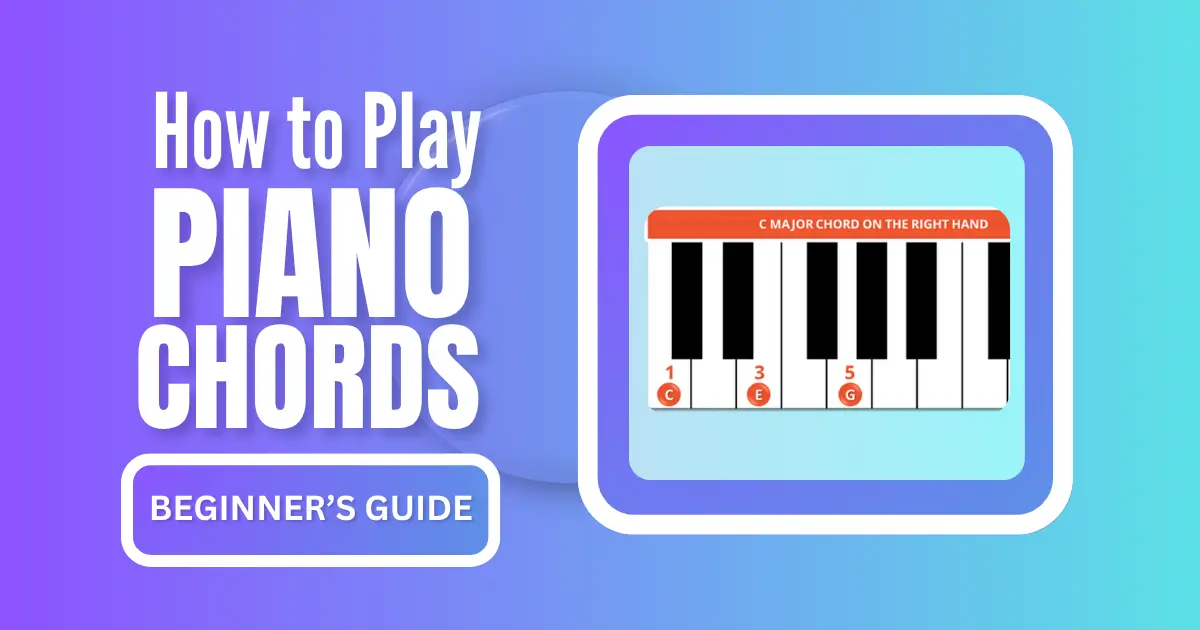
A chord is simply a group of three or more notes played together at the same time. These notes are usually spaced in intervals, and they work together to create a sound that feels complete.
The most basic chord is the triad—a three-note chord. The most common triads are built from the first, third, and fifth notes of a scale. For example:
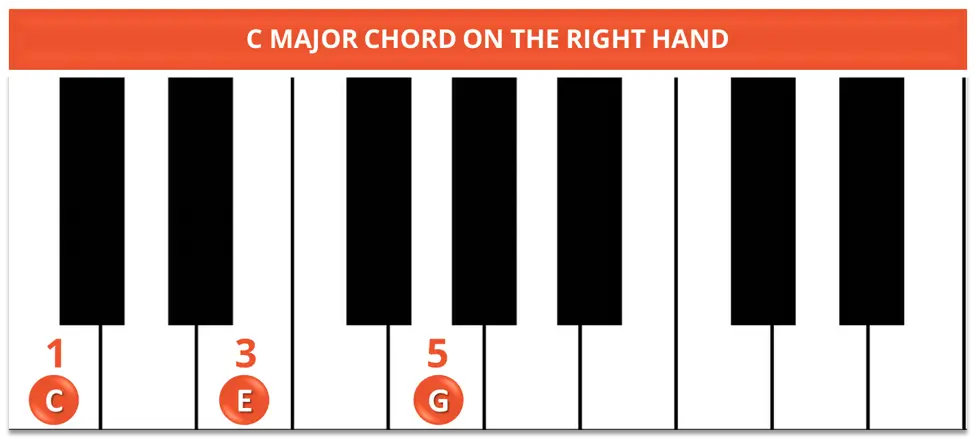
- In C Major, the chord is made up of C – E – G.
- In A Minor, the chord is made up of A – C – E.
Types of Chords:
- Major Chords: Bright and happy (C Major: C – E – G).
- Minor Chords: Sad or emotional (A Minor: A – C – E).
- Diminished Chords: Tense and unstable (C Diminished: C – E♭ – G♭).
- Augmented Chords: Dreamy and mysterious (C Augmented: C – E – G♯).
What Is Harmony?
Harmony is the simultaneous combination of different chords and notes that sound pleasing when played together. It’s what fills out a piece of music and gives it depth.
Think of melody as the main voice of a song, and harmony as the background that supports and enhances it. A strong harmony can make a simple melody feel powerful, while a subtle one can make a complex melody sound smooth.
How Harmony and Chords Affect Music
Chords and harmony are what make music feel alive. They can convey joy, sadness, excitement, and calmness, all depending on how they’re used. A song without harmony can feel empty, while a song with rich chords and harmony feels full and complete.
What are Chord Progressions?
Chord progressions are a series of chords played in a specific order. They’re the musical backbone of most songs, giving structure and emotional flow. The most common chord progression is the I-IV-V progression. In the key of C major, that would be:
- I (C major) – IV (F major) – V (G major)
This progression creates a sense of tension and release. The V chord (G) creates a feeling of wanting to resolve back to the I chord (C), giving the song a sense of closure or satisfaction.
Note Values & musical rest
What Are Note Values?
Note values tell you how long a note lasts in music. They’re like time stamps, letting you know when to play a note—and how long to hold it before moving on.
In most music, time is measured in beats, and the quarter note often gets 1 beat (especially in 4/4 time). Other note values are either longer or shorter than a quarter note.
Basic Note Values
Here are the most common note durations you’ll come across:
| Note | Symbol | Beats (in 4/4 time) |
|---|---|---|
| Whole Note | 𝅝 | 4 beats |
| Half Note | 𝅗𝅥 | 2 beats |
| Quarter Note | 𝅘𝅥 | 1 beat |
| Eighth Note | 𝅘𝅥𝅮 | ½ beat |
| Sixteenth Note | 𝅘𝅥𝅯 | ¼ beat |
Pro Tip: The smaller the note, the faster it moves!
What is a Musical Rests?
A musical rest is a symbol in sheet music that represents silence—a period where no note is played. Just like notes show you when to play, rests show you when to pause. Each type of rest corresponds to a specific note duration, meaning the silence lasts for the same amount of time as that note would.
| Rest Symbol | Name | Beats |
|---|---|---|
| 𝄻 | Whole Rest | 4 |
| 𝄼 | Half Rest | 2 |
| 𝄽 | Quarter Rest | 1 |
| 𝄾 | Eighth Rest | ½ |
| 𝄿 | Sixteenth Rest | ¼ |
Dynamics: Adding Expression & Emotion to Your Music
As you progress with the technical elements of music, it’s also important to understand how to add emotion and expression through dynamics. Dynamics are the variations in loudness and softness in music. These are the tools that let musicians convey feelings like joy, sadness, anger, or calmness.
What Are Dynamics?
Dynamics refer to how loud or soft the music is played. These changes can be gradual or sudden, depending on the music and the desired effect. They help shape the emotion and intensity of a piece of music.
Common dynamic markings include:
- Piano (p): Soft
- Forte (f): Loud
- Crescendo: Gradually getting louder
- Decrescendo (or diminuendo): Gradually getting softer
| Symbol | Italian Term | Meaning |
|---|---|---|
| pp | pianissimo | very soft |
| p | piano | soft |
| mp | mezzo piano | moderately soft |
| mf | mezzo forte | moderately loud |
| f | forte | loud |
| ff | fortissimo | very loud |
| < | crescendo | gradually louder |
| > | decrescendo | gradually softer |
Tip: Think of dynamics as a conversation. You don’t speak every word at the same volume—and you shouldn’t play every note that way either!
How Dynamics Affect Emotion
By playing louder or softer, musicians can reflect a range of emotions. For example:
- A crescendo can build anticipation, like when something big is about to happen in a story.
- A decrescendo can create a feeling of calm or resolution, like bringing a story to a peaceful close.
These dynamic changes are what make music feel like it’s alive, with tension and release, excitement and calmness, all depending on how the musician controls the volume.
Articulations: Playing with Feeling
Music isn’t just notes on a page — it’s full of emotion. Two musicians can play the same melody, but one might make it feel soft and tender, while another turns it into something bold and dramatic.
What Are Articulations?
Articulations are symbols or instructions in sheet music that tell you how to play each note—whether it should be short, smooth, strong, or something else.
They add clarity, character, and emotion to a performance, just like punctuation adds meaning to a sentence.
| Symbol | Name | Meaning |
|---|---|---|
| · | Staccato | Play the note short and detached |
| — | Tenuto | Hold the note for its full value |
| ^ | Marcato | Play the note with strong emphasis |
| slur | Slur | Play the notes smoothly and connected |
| accent | Accent | Emphasize the note (but not as strongly as marcato) |
Musical Forms and Song Structures: Building Blocks of a Song
You’ve learned about notes, rhythm, dynamics—now let’s zoom out and look at the big picture. Just like a story has a beginning, middle, and end, music has form. This is how songs are structured, giving them a sense of order and familiarity.
What Is Musical Form?
Form is the overall structure of a piece of music. It shows how sections are repeated, changed, or contrasted. Form gives music its sense of direction—without it, a song would feel like a bunch of random sounds.
Common Musical Forms
Here are the most common forms you’ll encounter, especially as a beginner:
1. Binary Form (AB)
- Music has two contrasting sections.
- A is the first idea, B is different.
- Think of a dance with two different steps.
2. Ternary Form (ABA)
- A returns after B.
- You hear a theme, then a contrast, then the return of the theme.
- Often used in classical pieces and lullabies.
3. Verse–Chorus Form (ABAB)
- Super common in pop, rock, and folk songs.
- Verse = tells the story
- Chorus = the catchy part that repeats
- Can also expand to ABABCB (with a Bridge for variety)
| Form | Structure | Example Use |
|---|---|---|
| Binary | A – B | Simple dance pieces |
| Ternary | A – B – A | Classical & romantic music |
| Verse–Chorus | A – B – A – B | Pop, rock, country songs |
| Pop Song Format | A – B – A – B – C – B | Most radio-friendly music |
How to Read Sheet Music: A Beginner’s Guide
Reading sheet music can seem like learning a new language—but once you crack the code, a whole world of music opens up to you. Don’t worry—it’s not as scary as it looks. You’ve got this!
What Is Sheet Music?
Sheet music is the written language of music. It tells you what to play, when to play it, and how to express it. Think of it like a blueprint for music—it lays everything out so anyone, anywhere, can reproduce the same sounds.
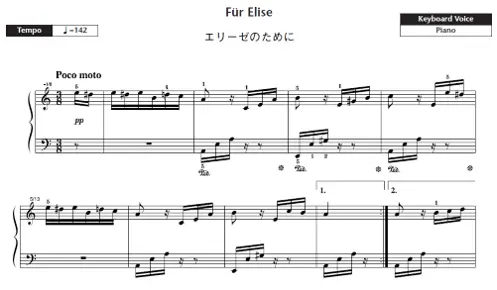
The Staff
At the core of sheet music is the staff:
It has five horizontal lines and four spaces, and each line or space represents a different musical pitch.
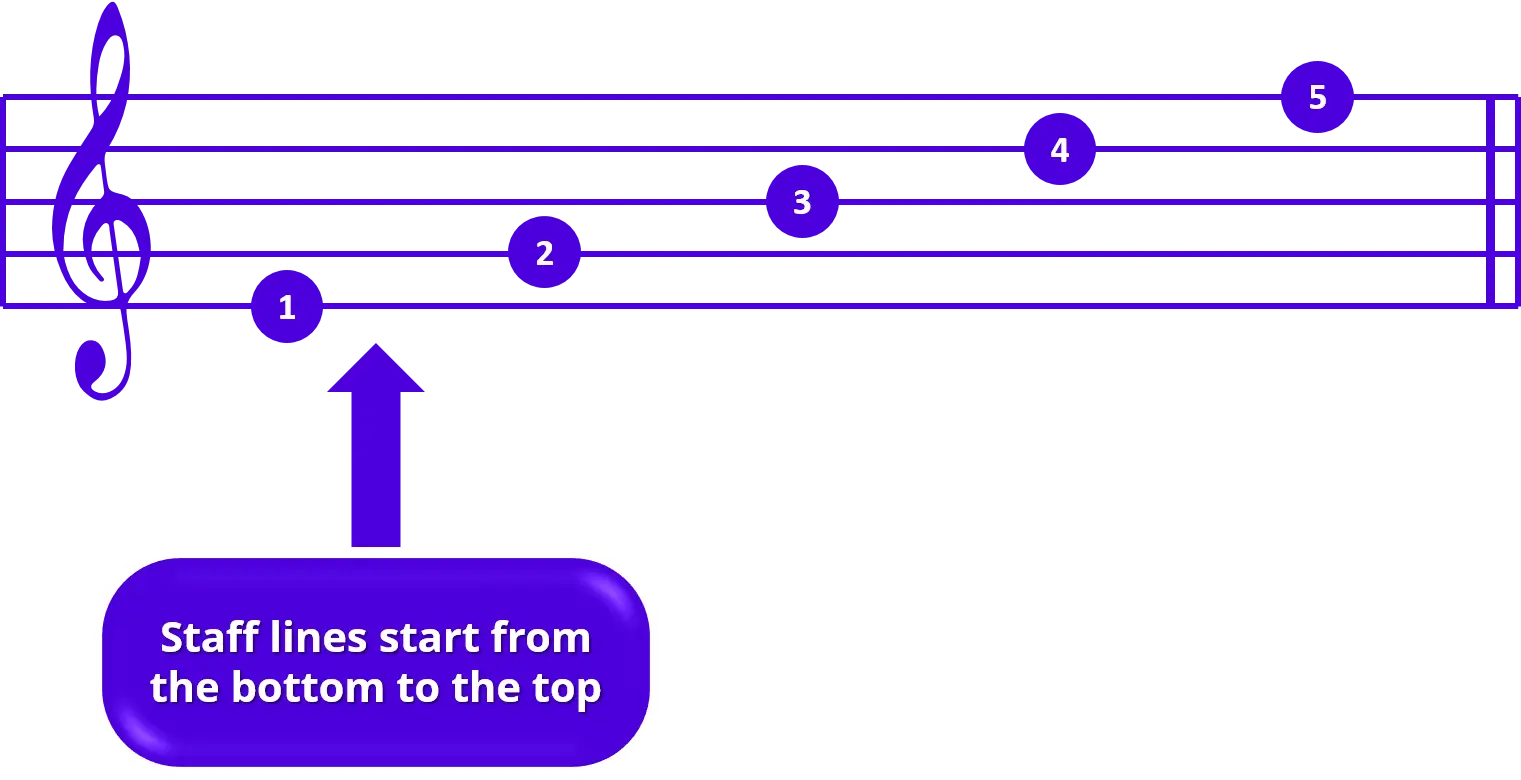
For more learning experience on how the musical staff works, check out
The Clefs
Clefs tell you which pitch belongs to each line and space.
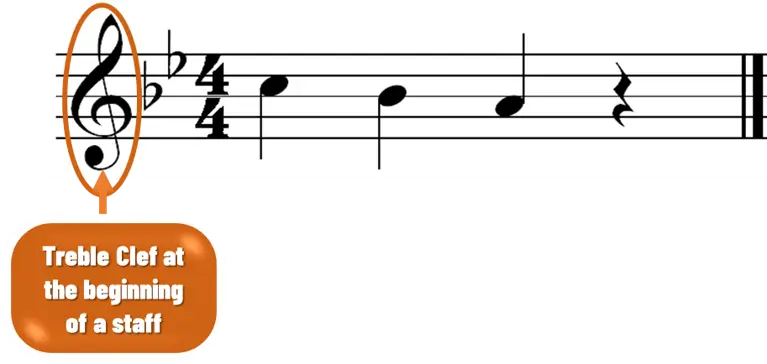
- Treble Clef (𝄞): For higher instruments like piano (right hand), violin, and flute.
- Bass Clef (𝄢): For lower instruments like piano (left hand), cello, and bass guitar.
Each clef adjusts what the lines and spaces mean. Most beginners start with treble clef.
To learn more about music clef, check out
Notes on the Staff
Where the note sits on the staff tells you its pitch. What the note looks like (whole, half, quarter) tells you its duration.
You might also see:
- Ledger lines: small lines above or below the staff to extend the range.
- Rests: symbols for silence.
- Dots and ties: to extend note lengths.
Time Signatures
Found at the beginning of the music, time signatures tell you how many beats are in each measure, and what type of note gets the beat.
Example:
- 4/4 = 4 beats per measure, quarter note gets 1 beat
- 3/4 = 3 beats per measure (like a waltz)
- 6/8 = 6 eighth notes per measure, grouped in 2 strong beats
Key Signatures
Right next to the clef, you’ll see the key signature, which tells you which notes are always sharp or flat. This saves you from writing accidentals (♯/♭) over and over again.
Ear Training and Aural Skills: Develop Your Musical Ear
Reading music is one thing, but hearing it—that’s where the real magic begins. Ear training helps you recognize notes, intervals, rhythms, and chords by ear, without needing to look at sheet music. It’s like giving your brain a built-in music translator.
What is Ear Training?
Ear training (also called aural skills) is the practice of improving your ability to identify musical elements just by listening. It trains your ear to:
- Recognize intervals (the space between two notes)
- Identify chords and chord progressions
- Pick up on rhythms
- Transcribe melodies by ear
- Sing or play back what you hear
This is a skill every great musician uses—whether they’re improvising jazz, composing, or just jamming with friends.
Frequently Asked Questions (FAQs)
1. What is music theory, and why is it important?
Music theory is the study of the structure and language of music. It helps you understand how music works, which makes it easier to play, compose, and appreciate music more deeply.
2. Do I need to learn music theory to play an instrument?
Not necessarily—but learning music theory can massively boost your understanding, creativity, and confidence as a musician. It’s like having a roadmap instead of wandering in the dark.
3. What should I learn first in music theory?
Start with the basics: notes, rhythm, the staff, clefs, scales (especially major and minor), and intervals. These fundamentals set the foundation for everything else.
4. Is music theory hard to learn?
It might seem tricky at first, but with consistent practice and real-life application, it becomes much easier. Think of it like learning a new language—step by step, it makes more sense.
5. How long does it take to learn basic music theory?
You can learn the basics in a few weeks if you study a little each day. Mastery, of course, takes longer—but even basic theory can make a huge difference in your musical progress.
6. What’s the difference between major and minor scales?
Major scales sound bright and happy, while minor scales sound more serious or sad. The difference comes from the arrangement of whole and half steps between notes.
7. Can I learn music theory online for free?
Absolutely! There are tons of free resources—like blogs, YouTube tutorials, music apps, and interactive websites (like musictheory.net). You’re already off to a great start right here.
8. What are intervals in music theory?
An interval is the distance between two notes. Intervals are crucial for understanding harmony, melodies, and chords.
9. Do professional musicians use music theory?
Yes—whether they realize it or not! Even if someone plays by ear, they’re often using principles of theory instinctively. Formal training just gives you more tools and vocabulary.
10. What’s the best way to practice music theory?
Apply it! Don’t just read—play scales, analyze songs, write simple melodies, use apps, and listen actively. Music theory is meant to be lived and experienced, not memorized in isolation.
Final Thoughts: Your Musical Journey Starts Here
If you’ve made it this far on the journey of theory of music—congratulations! You’ve just taken your first major step into the beautiful world of music theory.
Whether you’re picking up an instrument for the first time, returning after years away, or simply curious about how music works, understanding the basics of music theory gives you power. The power to express yourself, to understand what you’re hearing, and to create music with confidence.
Remember, you don’t have to learn everything overnight. Music is a journey, not a race. Take your time, revisit the concepts, practice a little each day, and—most importantly—enjoy the process.
Music theory isn’t about rules—it’s about unlocking creativity. So go ahead: play, explore, ask questions, and let your curiosity lead the way.
You’ve got this.
Now go make some music!